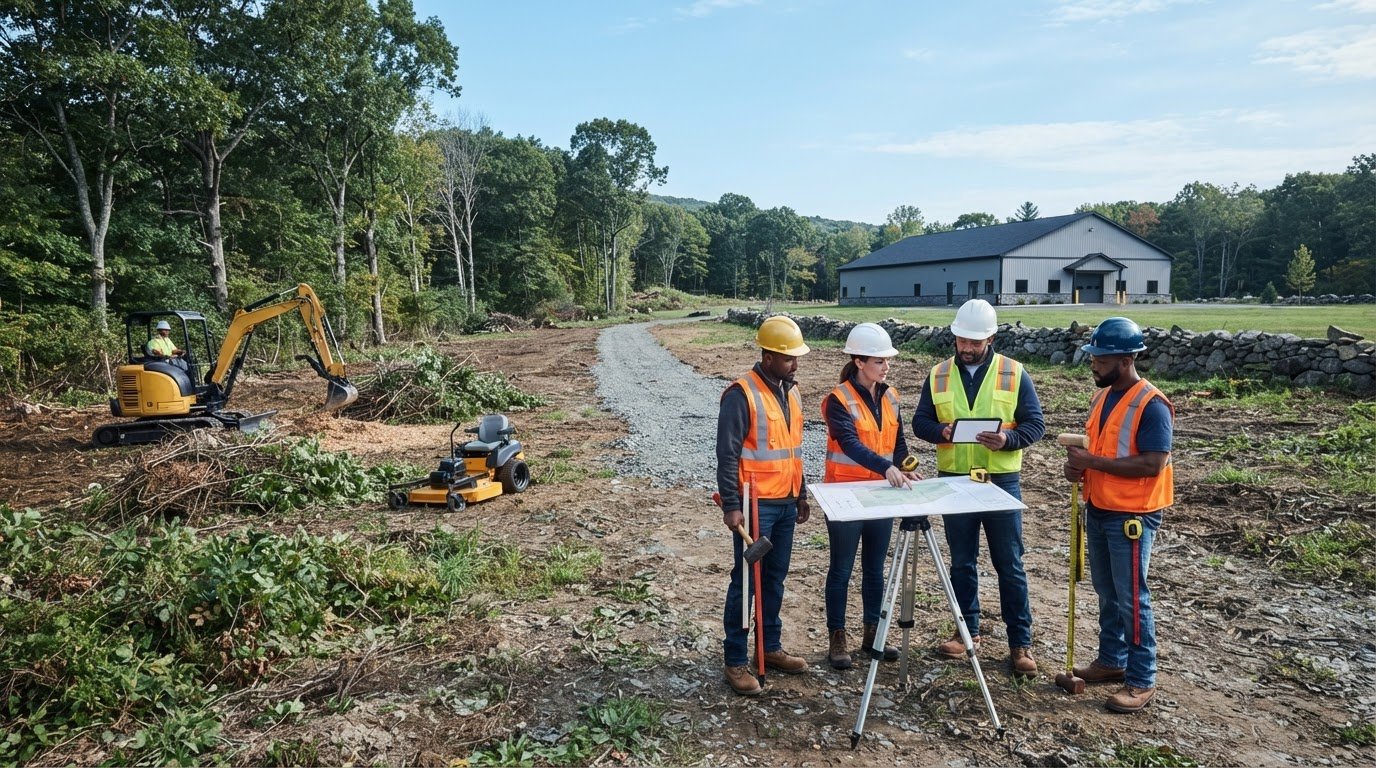
The most extensive clearing plan isn’t always the right one for a commercial property. The best approach depends on what the site needs to support next, whether that means opening access, managing overgrowth, or preparing a defined area for planned work. For commercial property land clearing in Connecticut, the intended use and existing site conditions should shape the scope from the start.
Before work begins, get clear on what will be removed, how debris will be handled, and how the work area relates to access and upcoming plans. A defined scope connects those decisions to the property’s priorities instead of treating every overgrown site the same way.
This guide compares practical clearing approaches through project examples and explains how vegetation, site layout, access, and debris needs influence planning. It also covers what to gather before discussing a project, so you can describe your Connecticut property’s condition and intended use clearly.
Key Takeaways
- Start with the property’s intended use. Access improvements, upkeep, and redevelopment can call for different clearing goals.
- Compare selective removal, broader clearing, and mulching based on vegetation, site access, and debris needs.
- Use the illustrative project examples to see how a site’s starting condition and desired outcome can shape a commercial property land clearing plan.
- Before discussing a project, map the work areas, access points, features to retain, known site constraints, and debris expectations.
- Pro Air Cleaners provides commercial land clearing and dump removal from its New Britain base, serving properties across Connecticut, Massachusetts, and New York.
Commercial Property Land Clearing: Start With the Site’s Intended Use
Commercial property land clearing removes unwanted vegetation and site debris to prepare or maintain a commercial property for its intended use. Let that use guide the scope. A property being prepared for planned site work may need a defined area cleared. A business maintaining usable grounds may need overgrowth removed from selected spaces while keeping features that remain in use undisturbed.
Start by describing the result you need, not just the problem. “Clear the back lot” can mean different things. “Open a route to the rear boundary while retaining the marked tree line” gives the work a clear reference point. Describe results that can be seen and agreed on, such as a specified area cleared, an access route opened, or identified vegetation retained. These details turn a broad request into a practical scope.
Site size alone doesn’t determine the amount or type of work. A small area with dense vegetation or limited access may need different planning from a larger, open site. The goal, site conditions, and debris plan all matter.
Which commercial property goals can clearing support?
Planned work and ongoing property upkeep have different priorities. For redevelopment or other planned site work, the goal may be to clear a defined work area and identify what should remain outside it. For routine upkeep, the focus may be removing unwanted growth from selected grounds while keeping the property’s current use in mind.
Clearing can also improve access for inspections, regular maintenance, or future planning by making a route or area easier to reach and view. Define success in observable terms: a marked path is accessible, a chosen section is free of unwanted vegetation, or specified features remain undisturbed. These agreed outcomes give the property owner and clearing team a shared reference point.
What site conditions shape the scope?
Before setting the work area, consider vegetation density, where crews can enter and move, changes in terrain, and whether accumulated debris is present. These conditions affect how the project is organized and what needs to be addressed. Decide early whether material will remain on the property or be removed, since those are different final outcomes.
Mark both sides of the plan: the areas to clear and the features or sections to retain. A simple site sketch can show access points, boundaries, sensitive or regularly used areas, and visible constraints. This reduces ambiguity, especially when the work area doesn’t follow the parcel boundary. For a broader planning overview, see land clearing services in Connecticut.
The clearing approach should match the intended result. For example, Clearcutting describes broad vegetation removal, but a commercial property may call for selective work instead. Treat the method as a planning decision, not a default. The goal and site conditions should determine the scope.
Commercial Land Clearing Approaches: Match the Work to the Property
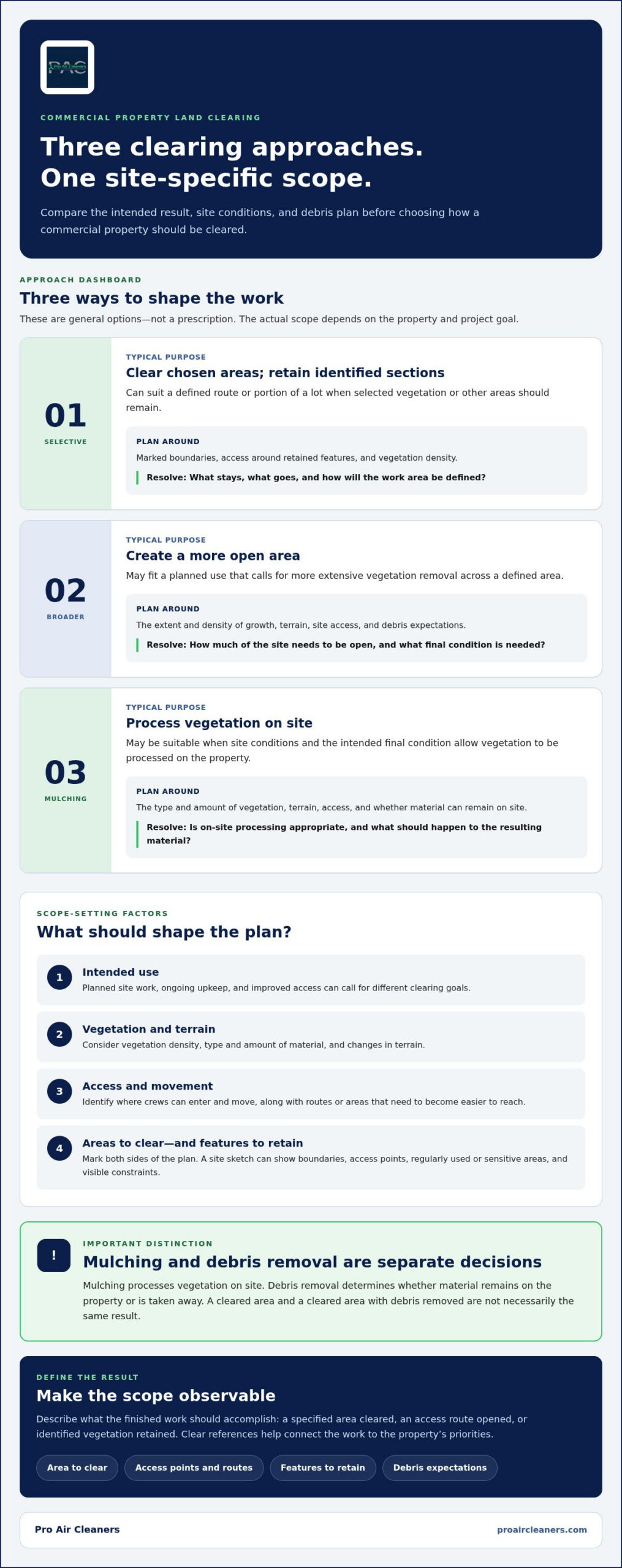
No single clearing approach suits every commercial site. Selective vegetation removal, broader clearing, and on-site mulching are general industry options, each leading to a different site condition. Compare them against the property’s intended use, vegetation, access, features to retain, and debris plan. This helps owners describe the outcome they need without assuming one method fits every parcel.
Use the table as a planning aid, not a prescription. These are broad descriptions. The final scope depends on the actual site and project goals.
| Approach | Typical purpose | Site considerations | Questions to resolve |
|---|---|---|---|
| Selective removal | Clear chosen areas while retaining identified vegetation or other sections. | Marked boundaries, access around retained features, and vegetation density. | What stays, what goes, and how will the work area be defined? |
| Broader clearing | Create a more open area where the intended use calls for more extensive vegetation removal. | Extent and density of growth, terrain, site access, and debris expectations. | How much of the site needs to be open, and what final condition is needed? |
| Mulching | Process vegetation on site where conditions make that approach suitable. | Type and amount of vegetation, terrain, access, and whether material can remain on site. | Is on-site processing appropriate, and what should happen to the resulting material? |
When might selective clearing or broader site clearing fit?
Selective work may suit a property owner who wants to clear a defined route or portion of a lot while keeping chosen vegetation outside the work area. Broader clearing may fit a different goal, such as creating more open space across an area planned for a new use. These hypothetical scenarios illustrate the difference: the key question is how much vegetation must be removed to meet the property’s goal.
How do mulching and debris removal differ?
Mulching processes vegetation on site, but it isn’t suitable for every combination of material, terrain, access, or intended final condition. Debris removal is a separate decision about whether material remains on the property or is taken away. Make that expectation explicit. A cleared area and a cleared area with debris removed aren’t necessarily the same result.
For a construction-focused perspective, the land clearing for construction guide offers related preparation context. For commercial property land clearing, write down your preferred outcome, retained areas, access needs, and debris expectations before choosing an approach. Pro Air Cleaners provides land clearing and dump removal for commercial properties. Learn more about commercial land clearing services.
Three Commercial Property Land Clearing Examples by Project Goal
These hypothetical scenarios show why commercial property land clearing should reflect the intended use of each part of a site. For any project, clarify the starting condition, desired outcome, and constraints before defining the scope.
Illustrative example: Preparing an overgrown commercial lot for planned work
- Starting condition: Dense growth makes it difficult to see across parts of a hypothetical commercial lot and reach the intended work area.
- Property goal: Clear the portion needed for planned work instead of assuming the entire parcel needs the same treatment.
- Planning considerations: Mark the work area, identify vegetation or site features to retain, and discuss how clearing and debris handling relate to the next phase. Set the scope around the planned use without assuming a particular construction outcome, permit status, or schedule.
- Intended outcome: A clearly defined area is cleared to the agreed scope, with retained areas identified.
Key scope question: Which specific area needs to be cleared for the planned next step?
Illustrative example: Improving access and maintaining a commercial property
- Starting condition: Vegetation has grown along a route used to reach part of the property or makes routine upkeep more difficult.
- Property goal: Restore access to the selected area or route while keeping other parts of the parcel as they are.
- Planning considerations: Identify where access is needed, which areas are regularly used, and what vegetation should remain. A targeted scope may address the route or affected area without clearing the entire property. Property owners planning work in the area can also review this New Britain land clearing guide for local context.
- Intended outcome: The designated route or area is more accessible, while agreed retained sections stay outside the work scope.
Key scope question: What access or upkeep problem should the clearing directly address?
Illustrative example: Maintaining open grounds while retaining selected vegetation
- Starting condition: A commercial property has a mix of open grounds and unwanted growth near selected boundaries or less-used areas.
- Property goal: Maintain the areas important to ongoing property use without treating every section as a clearing zone.
- Planning considerations: Mark the sections for attention and note what should be retained. Include the expected debris outcome in the scope, since processing vegetation on site and removing debris are different considerations.
- Intended outcome: The selected areas are addressed according to the property’s upkeep needs, with boundaries and debris expectations understood.
Key scope question: Which areas need attention, and what should the property look like when that work is complete?
Across all three examples, the same approach won’t suit every property. A defined access route, a planned work area, and grounds needing selective upkeep each call for a different description of success. Clear boundaries and observable outcomes help owners explain what the work should accomplish before discussing the scope.
Plan a Connecticut Commercial Clearing Project With Fewer Surprises
A clear project brief connects the property’s current condition with its next use. For commercial property land clearing, prepare a simple site map and a written description of the desired outcome. These details give the project team a useful starting point for discussing scope, access, debris expectations, and coordination with other planned site work.
What information should a property manager gather?
Gather the details that distinguish one part of the property from another. A site sketch doesn’t need to be a technical drawing. It should make work areas, access, retained features, and known constraints easy to understand. Use this sequence to organize the project discussion:
- Define the goal. Describe what the cleared area should support, such as planned work, improved access, or routine property upkeep.
- Locate the work. Record the property address and approximate area involved, then mark the requested work boundaries on a map or sketch.
- Show access. Note available entrances and routes to the work area, along with access limitations or areas that need to remain available.
- Describe site conditions. Point out vegetation concerns, accumulated debris, terrain changes, and other known constraints that may affect planning.
- Mark what stays. Identify vegetation, features, and sections to retain or keep undisturbed so the intended scope is clear.
- Share coordination needs. Note known timing considerations, access needs, and how clearing may relate to other planned work on the property.
State what you expect for debris at the end of the work. Clarifying whether material should remain on site or be removed defines the intended final condition and keeps that decision from getting lost among the clearing details.
How can Connecticut location affect project planning?
Local requirements and environmental considerations can vary by municipality and by site. Before work begins, review the rules that apply to the property and its planned use rather than assuming guidance for one town fits another. New Britain is a useful local reference for properties there, but its requirements shouldn’t be treated as statewide rules. Include relevant town guidance and site-specific environmental considerations in project preparation.
Location also shapes coordination. The project discussion should reflect the specific property, its intended use, and any constraints already identified. A map that distinguishes work areas from access routes and retained features makes those details easier to communicate. If the intended use changes, revisit the proposed scope to make sure it still supports the property’s plans.
Once your goals, site notes, and debris expectations are assembled, discuss commercial land clearing with Pro Air Cleaners. This preparation helps focus the project conversation on the property’s needs.
Work With Pro Air Cleaners on Commercial Property Land Clearing
Pro Air Cleaners is based in New Britain, Connecticut, and provides commercial land clearing and dump removal for properties across Connecticut, Massachusetts, and New York. With over 30 years of experience, the company understands that each property has its own priorities. A useful project discussion begins with what the site needs to support, then connects that goal to the work area, access, vegetation, and debris-management expectations.
That context matters whether you’re preparing a specific part of a property for planned work or addressing overgrowth that affects regular use. Instead of assuming the same scope suits every site, describe the intended outcome and the areas involved. This gives the conversation a practical focus and helps shape a clearing plan around the property.
What to expect when discussing a commercial clearing project
For a focused discussion, share the site location, its intended use, the areas you want addressed, and any known constraints. A map or marked-up aerial image can show boundaries, access points, sections to retain, and places where vegetation or accumulated material is a concern. Include relevant details about property access and coordination with other planned work.
These details help frame the project scope around the site rather than a general description of clearing. They also distinguish the desired clearing outcome from debris-handling expectations, which may be a separate part of the discussion.
- Property goal: What should the cleared area support?
- Work boundaries: Which areas are included, and which should remain undisturbed?
- Site context: What vegetation, access conditions, or known constraints should be considered?
- Debris expectations: Is accumulated material part of the site’s cleanup needs?
When land clearing and dump removal support the same goal
Vegetation and accumulated material can both affect how a commercial property is used, but they’re distinct parts of project planning. Land clearing addresses unwanted vegetation; dump removal addresses material that needs to be taken away. Depending on the property’s condition and intended use, either service may be relevant, or both may support a broader site-preparation goal. They aren’t a fixed package or a requirement for every clearing project.
For example, a property owner may want to address overgrowth in a defined area and accumulated debris elsewhere on the site. Describing each need separately keeps the scope clear and ties the requested work to the site’s next use. Pro Air Cleaners provides commercial land clearing and dump removal for property owners across its service area, with the project discussion focused on the property’s needs.
Bring your site details and intended outcome to the conversation, then discuss your commercial property clearing project with Pro Air Cleaners. A clear starting picture helps turn a broad property concern into a focused next step.
Turn Your Property Plans Into a Clear Next Step
A commercial site can change as business needs and plans develop, so commercial property land clearing starts with a clear purpose for the work. Decide what the property needs to support next and who should be part of the project discussion. A shared understanding helps keep the focus on a useful outcome rather than clearing more or less than the site requires.
Use the project discussion to align the intended result with the property’s practical needs. If priorities shift, bring those changes into the conversation before the scope is settled. That gives everyone a shared picture and helps determine how clearing and debris management fit the site’s next use.
When you’re ready to take the next step, start a conversation about your property’s clearing needs with Pro Air Cleaners.
Frequently Asked Questions
What does commercial property land clearing usually include?
Commercial property land clearing generally addresses unwanted vegetation and may involve related site debris, depending on the project scope. The work can range from vegetation removal in a limited area to clearing a wider section of land. Before discussing a project, identify the types of growth or material involved and describe the condition you want the area to have afterward.
How do I know whether a commercial property needs selective or full clearing?
Selective clearing may fit when the property’s planned use depends on keeping certain areas or vegetation in place. Broader clearing may be appropriate when the intended use calls for a more open area. Consider whether the site will remain in active use during the work and whether preserving boundaries or natural screening matters. A marked site plan helps compare these priorities and define how much land to include.
Does commercial land clearing include debris removal?
Not necessarily. Clearing vegetation and removing accumulated material are related needs, but they’re distinct parts of a project scope. Pro Air Cleaners provides both land clearing and dump removal. Describe what material is present and whether you expect it to be removed. This clarifies the intended site condition without assuming debris removal is automatically included.
How long does commercial property land clearing take?
There isn’t one reliable duration for every commercial site. The amount and density of vegetation, ground conditions, access, work area, debris handling, and coordination with other property activity can all affect the schedule. A small, accessible section and a large, overgrown parcel involve different scopes. Share timing constraints early, especially if tenants, deliveries, inspections, or other planned work depend on access.
Do I need permission to clear commercial land in Connecticut?
Requirements can depend on the property’s location, the nature of the work, and site conditions. Before clearing, contact the relevant town offices to learn which local land-use or environmental rules may apply, and check with the appropriate state agency if site-specific environmental concerns are involved. Don’t assume guidance for another Connecticut municipality applies to your property. Confirm the requirements for the exact parcel and planned work.
Can land clearing be planned while keeping some trees or vegetation?
Yes. A clearing scope can identify vegetation or sections to retain instead of treating the whole property as one work area. Mark those areas clearly on a site plan and use visible labels or boundary markers during the project discussion. Note why they should remain, such as for screening, shade, or separation from an active area. Clear distinctions reduce the chance that retained features are confused with vegetation designated for removal.
What should I prepare before requesting commercial land clearing?
Gather the property address, a site plan or map, and recent photos showing the areas of concern. Note the intended use of each work area, access limitations, vegetation types, accumulated material, features to preserve, and coordination needs. If you have a survey or relevant property documents, keep them available for reference. This gives the project discussion a concrete starting point and helps identify details that may need follow-up.