
Before moving anything, take a moment to assess the site. Branches, renovation scraps, bulky items, and mixed materials can require different handling and disposal plans. For debris removal for property owners, identifying what is on site, where it can be staged, and how the space will be used next helps prevent avoidable hazards and delays.
Start by noting what needs clearing, what must remain accessible, and whether any material looks unfamiliar or unstable. Connecticut collection rules and facility guidelines can vary, so check current local instructions before setting debris out for pickup. This guide explains how to assess the work, organize familiar materials, and plan a safer cleanup while keeping access and potential hazards in view.
You’ll also learn when professional dump removal can help with accumulated debris and when land clearing may suit outdoor site preparation or reclaiming space. Pro Air Cleaners provides dump removal and land clearing for residential and commercial properties in Connecticut, helping owners plan a more orderly cleanup.
Key Takeaways
- Start debris removal for property owners by defining how the cleared area will be used, then assess the materials, access, and scope of work.
- Record where debris is located and separate visually distinct materials where practical to make cleanup planning more orderly.
- Keep people away from suspected electrical hazards. Do not disturb them, and seek appropriate professional guidance.
- Compare owner-managed cleanup, municipal collection, and professional removal. Local collection arrangements may not cover every project.
- Pro Air Cleaners provides dump removal for accumulated debris and land clearing for outdoor site preparation or reclaiming space.
What Counts as Property Debris on Connecticut Homes and Sites?
Debris is unwanted material that needs to be removed from a property or site. It may come from yard work, a home improvement project, a storm, or items that have accumulated over time. Its source and condition help determine what to do next: a pile of clean branches is different from mixed material that includes damaged building components or household belongings. For debris removal for property owners, the first step is to understand both what needs clearing and what the space must support afterward.
Common debris categories property owners encounter
Cleanup often brings several kinds of material together. Typical examples include leaves and brush from yard maintenance, renovation remnants, fallen limbs, and bulky items stored outdoors or in a garage. Demolition waste can include materials from dismantled structures; the linked overview describes common composition and recovery considerations.
- Yard and vegetation debris: Leaves, branches, brush, and other plant material gathered during seasonal maintenance or outdoor work.
- Renovation remnants: Pieces of lumber, flooring, drywall, siding, and packaging left after a repair or remodeling project.
- Storm debris: Fallen limbs, scattered outdoor items, or damaged building materials after severe weather.
- Accumulated bulk items: Furniture, large household objects, and other belongings taking up space around a home or site.
A mixed pile may contain several categories, so don’t assume it is all one kind of load. Where practical, separate materials that are visibly different and note anything whose contents or condition are uncertain. The source also matters: ordinary project offcuts differ from material left by a major storm, and that context can affect handling and disposal decisions. Demolition waste is one reference for understanding material from building removal.
Routine cleanup debris comes from everyday maintenance or planned projects. Disaster-related debris follows a disruptive event and may call for a more coordinated cleanup approach.
How the property’s purpose changes the cleanup
At an occupied home, the goal may be to restore a driveway, yard, or storage area while keeping household access clear. At a rental property, accumulated items may need to be cleared from shared areas or outdoor space. On a commercial site, keeping access routes and work areas functional may be a priority during cleanup.
Land preparation has a different endpoint. The aim may be to reclaim an overgrown area or prepare outdoor space for its next use, rather than simply remove scattered items. Define the outcome first: clearing accumulated debris is not the same task as preparing land. A guide to residential dump removal services can help homeowners consider how professional removal may fit a larger cleanup, while land clearing is suited to outdoor site preparation.
How to Approach Debris Safety on a Connecticut Property
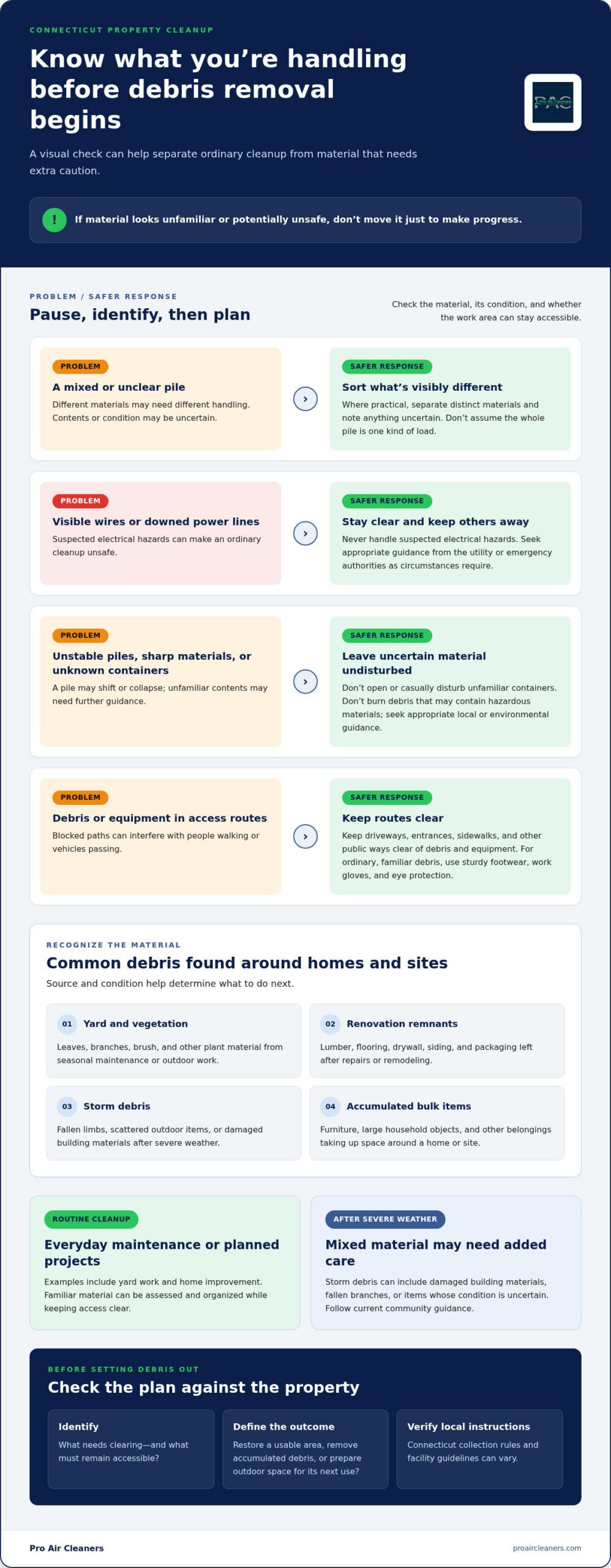
A debris pile doesn’t automatically signal danger, but a visual check can help you decide what is reasonable to handle and when to stop. Consider the material’s condition, whether the pile appears stable, and whether there is enough room to work without blocking access. If something looks unfamiliar or potentially unsafe, don’t move it just to make progress.
Warning signs that call for extra caution
Pause if you see visible wires, unknown containers, sharp materials, or a pile that could shift or collapse. Keep children, visitors, and pets away. Never handle suspected electrical hazards yourself. Stay clear and seek appropriate guidance from the utility or emergency authorities as circumstances require.
Use similar restraint with unknown substances. Don’t burn debris that may contain hazardous materials, and don’t open or casually disturb unfamiliar containers. If you can’t identify an item or determine whether it is safe to move, leave it in place and seek guidance from the appropriate local or environmental authority. Recognizing when not to proceed can keep a routine cleanup from becoming more complicated.
Protect people and keep access routes clear
For ordinary, familiar debris, wear practical protection such as sturdy footwear, work gloves, and eye protection. Work at a steady pace, keep the area organized, and avoid placing piles where people need to walk or vehicles need to pass. Keep driveways, entrances, sidewalks, and other public ways clear of debris and equipment.
Storm cleanup calls for added care because debris may be mixed with damaged building materials, fallen branches, or other items whose condition is uncertain. FEMA’s disaster-cleanup guidance offers a useful principle: stay away from downed power lines and don’t burn debris that may contain hazardous materials. That advice is for disaster-related cleanup and does not replace current directions for your community or situation. For Connecticut waste reduction, reuse, and recycling information, consult Connecticut DEEP Waste Management, along with current local guidance for storm debris.
Separate familiar material from anything that needs further guidance. If a pile includes ordinary yard waste and unfamiliar items, don’t assume they should be handled the same way. This distinction is important in debris removal for property owners: a clear safety boundary helps identify which work can proceed and which material should remain untouched until its next steps are understood.
When the volume or layout makes owner-managed cleanup difficult, professional dump removal can help address accumulated debris and keep the work area more orderly. Pro Air Cleaners’ dump removal service serves residential and commercial properties in Connecticut.
Which Debris Removal Approach Fits Your Connecticut Property?
The right approach depends on more than the size of the pile. Consider how difficult the material is to handle, whether the work area is accessible, and what the space needs to be ready for afterward. Use this comparison to choose a sensible starting point without assuming every cleanup suits the same method.
| Approach | May fit when | Consider |
|---|---|---|
| Owner-managed cleanup | The amount is limited, the material is familiar, and the work area is safely accessible. | Account for your available time, lifting demands, and ability to handle the material safely. Don’t take on unknown, unstable, or potentially hazardous debris. |
| Scheduled municipal collection | Your municipality has a collection arrangement that applies to your items and project. | Schedules, accepted items, placement instructions, and project eligibility can vary. Don’t assume curbside collection is available for every cleanup; review current local guidance first. |
| Professional removal | The cleanup involves a larger accumulation, more involved handling, or a site that needs a defined next use. | Consider the project’s scale, the access available, and whether the goal is to clear accumulated debris or prepare an outdoor area. |
When a small cleanup may be manageable independently
A modest amount of familiar yard material or project remnants may be manageable if the area is accessible and the work feels reasonable. Be realistic about the time involved, whether items are awkward to lift, and whether you can keep the work area organized. If material is unknown, unstable, or potentially hazardous, pause instead of trying to clear it yourself.
Municipal collection can be useful when it fits the project, but arrangements vary by community. Review your municipality’s current instructions for timing, placement, and accepted materials. Keep piles on your property and out of travel paths. The Connecticut DOT Roadside Maintenance page provides context on roadside maintenance and debris, and reinforces the importance of keeping public infrastructure and access clear.
When professional dump removal or land clearing may fit
Professional dump removal can suit a property with accumulated debris or a cleanup that is difficult to manage independently. Land clearing is more closely aligned with preparing or reclaiming an outdoor site. The intended outcome matters: restoring usable space, improving access, and preparing land for a future purpose are distinct goals, and each shapes the work involved.
For larger projects, the Connecticut guide to heavy-duty dump removal offers a related perspective on matching removal to the cleanup. Pro Air Cleaners provides dump removal and land clearing for residential and commercial properties in Connecticut. Identify the site’s condition, access, and intended next use to help define a practical plan.
Planning Property Debris Removal: Assessment to Cleanup
A clear plan begins with the result you want, not with moving the first item. Define the cleanup area and its next use, then note anything that may affect safe access or the order of work. For debris removal for property owners, a simple site record can turn a scattered cleanup into an organized project.
Assess the site and define the cleanup goal
Decide whether the priority is clearing a yard, removing accumulated debris from a home or commercial property, or preparing an outdoor area for another use. That goal sets the scope. Clearing a walkway has different requirements from preparing a broader site, so describe the desired result in practical terms.
Site access and project scope shape the cleanup plan. Note which areas can be reached, which routes need to stay open, and how removal can proceed without disrupting the property’s use.
- Define the goal. Identify the specific space to clear and what it should be ready for afterward.
- Assess the debris. Record approximate pile locations and visible differences, such as vegetation in one area and renovation remnants in another. Describe what you can see without assuming material composition or disposal requirements.
- Note access. Mark narrow paths, slopes, occupied areas, gates, and routes that must remain open for people or property use.
- Plan handling. Decide whether the work appears manageable independently, fits a scheduled municipal collection, or may benefit from professional removal. Keep unfamiliar or potentially unsafe material out of the ordinary handling plan.
- Review the result. After cleanup, check the original pile locations and confirm that intended access and usable space have been restored.
Coordinate removal and review the cleared area
A brief site sketch or written checklist can keep important details in view. Note where piles sit in relation to entrances, driveways, buildings, and areas that need to remain in use. Separating visibly different materials can also make it easier to describe the project and plan the order of work, without assuming every material follows the same disposal route.
For Connecticut disposal instructions, consult current guidance from the municipality responsible for the property. Local collection schedules and requirements are separate from private-property removal arrangements, so don’t assume a municipal program covers the whole project. Review the applicable instructions before setting material out or organizing the cleanup around a collection date.
Coordinate the work around safe access and the property’s next use. Once removal is complete, check the original pile locations, paths, and entrances for leftover material or areas that still need attention. For substantial accumulated debris or outdoor site preparation, Pro Air Cleaners provides dump removal and land clearing for residential and commercial properties in Connecticut. Plan your property cleanup with Pro Air Cleaners.
How Pro Air Cleaners Helps Connecticut Property Owners Clear Debris
After identifying what needs attention and how the cleared space will be used, match the project to the right kind of service. Based in New Britain, the company brings more than 30 years of experience to property clearing and site-preparation work.
Dump removal for property cleanup
Dump removal is relevant when a home, rental, or commercial property has accumulated debris that needs clearing. The project’s scope, access, and intended use help frame the work. For example, a narrow approach or an occupied area may affect how cleanup is organized, while the end goal clarifies which spaces need attention. These considerations apply to a homeowner cleanup as well as a broader property project.
An owner may want to restore usable space around a residence, address accumulation at a rental, or clear an area on a commercial property. Note where the debris is and what outcome you want to make the project easier to plan. Homeowners looking for more focused information can explore the residential dump removal guide for details relevant to home cleanup.
Land clearing for outdoor site preparation
Land clearing suits outdoor projects where the goal is to reclaim or prepare an area of a property. It is intended for site preparation, rather than indoor cleaning or mold remediation. Defining the planned use of the outdoor space helps distinguish land clearing from dump removal, which focuses on accumulated debris.
If you are preparing an outdoor area, begin by noting its boundaries, access points, and intended next use. These details establish the project context without assuming a particular scope or result. The Connecticut land clearing planning guide offers additional context for thinking through outdoor site preparation.
Both services start with the same planning basics: identify the area, consider access, and define the purpose of the cleanup. The goal determines which service is more relevant. Accumulated debris points toward dump removal; preparing or reclaiming an outdoor site points toward land clearing. That distinction helps owners describe the work and plan around the property’s use.
For Connecticut owners considering debris removal for property owners, Pro Air Cleaners provides local property-clearing services for residential and commercial sites. Explore the company’s information on dump removal and land clearing to see how each service aligns with your project.
Take the Next Step Toward a More Usable Property
A cleanup can prepare a space for better use, not just remove a pile of debris. Picture how you want the area to function afterward: easier to access, ready for a planned project, or less crowded. That intended use gives your next decision a clear purpose and keeps the work focused.
For debris removal for property owners, progress starts with a practical first step and a clear idea of what a successful result looks like. Assess the materials, access, and scope before choosing whether to manage the cleanup yourself, use a municipal collection that fits, or arrange professional removal.
Pro Air Cleaners provides dump removal and land clearing from New Britain for Connecticut property owners, with more than 30 years of experience. Explore Pro Air Cleaners’ property-clearing services for your project.
Start with the outcome you want, then choose the cleanup approach that fits the property.
Frequently Asked Questions
What counts as debris on a private property?
Private-property debris may include unwanted vegetation, renovation remnants, storm material, sediment, or bulky items, depending on the site and cleanup. A garden-side pile might contain branches, while a renovation area could include several kinds of leftover building material. Identify what is visible and keep distinct categories separate as you plan. If an item is unfamiliar or may be hazardous, don’t casually move it; seek appropriate local guidance first.
Can property owners remove debris themselves?
Yes, owners may be able to manage a small amount of familiar debris if the area is accessible and the work feels manageable. Consider the time involved, lifting demands, and whether you can move items without straining yourself. Don’t handle visible electrical hazards or suspected hazardous substances. After a storm, review current local instructions and FEMA safety guidance, since damaged materials can make cleanup less straightforward.
How do I plan debris removal after a storm in Connecticut?
From a safe distance, look for immediate hazards, including visible wires, and keep people away from affected areas. Note where the debris is and the general materials you can identify. Then review your Connecticut municipality’s current collection and placement instructions, because arrangements differ by community. Don’t assume disaster-response collection applies to every private-property cleanup; follow local directions for the event and your location.
Does the town remove debris from private property?
Not necessarily. Municipal collection arrangements can differ and may apply only to particular events, materials, locations, or schedules. FEMA notes that local governments may collect certain disaster debris placed for pickup, but this does not mean every property or routine cleanup is covered. Before moving debris to a curb or other collection point, check the current instructions from the Connecticut municipality where the property is located.
When should I consider professional debris removal?
Consider professional help if the cleanup feels too large to manage, access is difficult, the work would take substantial time, or clearing is part of preparing the property for a new use. The right approach depends on the site and project goal. Dump removal can suit accumulated debris, while land clearing is intended for outdoor site preparation or reclaiming space.
What is the difference between dump removal and land clearing?
Dump removal generally addresses accumulated debris that needs to be cleared from a property, while land clearing focuses on preparing or reclaiming an outdoor area. Removing a buildup from a property is different from getting an outdoor site ready for a planned use. Pro Air Cleaners offers both services for residential and commercial properties in Connecticut, so owners can choose based on the cleanup objective.