
What if the hardest part of clearing an estate isn’t removal, but deciding what should happen to everything inside and around the property? If you’re researching estate cleanout services CT, start by defining the scope: what must stay, what can be removed, and whether the yard or other outdoor areas need attention. Clear decisions make it easier to plan the physical work around a property’s next use.
It’s understandable to feel unsure about what a cleanout covers. The right plan depends on the property, the material involved, and the outcome you’re preparing for. A home being renovated may need selected rooms cleared, while a property staying in the family may need only targeted removal. A written scope can help keep the work focused.
This guide explains how to organize decisions about belongings and debris, prepare for removal, and plan property clearing in Connecticut. Pro Air Cleaners, based in New Britain, provides dump removal and land clearing for residential and commercial properties. These services can support specific parts of a property-clearing plan, while decisions about personal belongings remain with the owner or authorized representative.
Key Takeaways
- Start with the property’s intended next use, then identify which rooms and outdoor areas need attention.
- Before arranging estate cleanout services CT, sort items into clear categories: keep, remove, or undecided.
- A sale, family transfer, renovation, or continued use can each call for a different removal scope.
- Describe property access, priority areas, and the material approved for removal before planning the work.
- Pro Air Cleaners provides dump removal and land clearing to support property maintenance and site preparation in Connecticut.
Estate Cleanout Services in CT: Process and Timing
Estate cleanout planning brings together decisions about a property and the physical removal needed for its next stage. The goal might be to prepare a home for sale, make it usable for a family member, or clear selected areas before renovation. The work can range from removing unwanted material from a few rooms to addressing both interior areas and outdoor spaces.
Define the intended outcome before removal begins. The owner or authorized representative should identify what stays, what has been approved for removal, and what still needs a decision. That step helps prevent belongings from being removed before ownership or family decisions are settled.
Property clearing addresses unwanted material; it doesn’t sort belongings, value them, or settle an estate. Removal is one practical part of a property transition, not a substitute for personal, financial, or legal decisions. For background on a separate process that may be relevant to some families, see Understanding Estate Sales and Liquidations.
When might a Connecticut estate cleanout be useful?
A cleanout plan may be useful after inheriting a home, during a move or downsizing, or when preparing a property for its next use. These transitions often involve both personal decisions and practical work. Connecting each removal decision to a specific property goal can help keep the plan manageable.
For example, renovation may require clearing the rooms where work will take place, while a home that will remain in family use may need only selected unwanted material removed. The timing depends on when decisions are ready and when the property needs to be cleared. A defined scope helps everyone understand which areas and items are included.
What does a property-clearing service address?
Dump removal addresses unwanted material that needs to be cleared from a residential or commercial property. For an estate-related project, that might mean clearing specified rooms, a garage, or another area so it can be used for the next step. Pro Air Cleaners provides dump removal as part of its property-clearing services.
Land clearing can address outdoor areas when they need attention for property maintenance or site preparation. It may be relevant alongside interior removal if the next use of the property depends on exterior clearing, but it is not automatically part of every project. Pro Air Cleaners is based in New Britain and brings more than 30 years of experience to its property services.
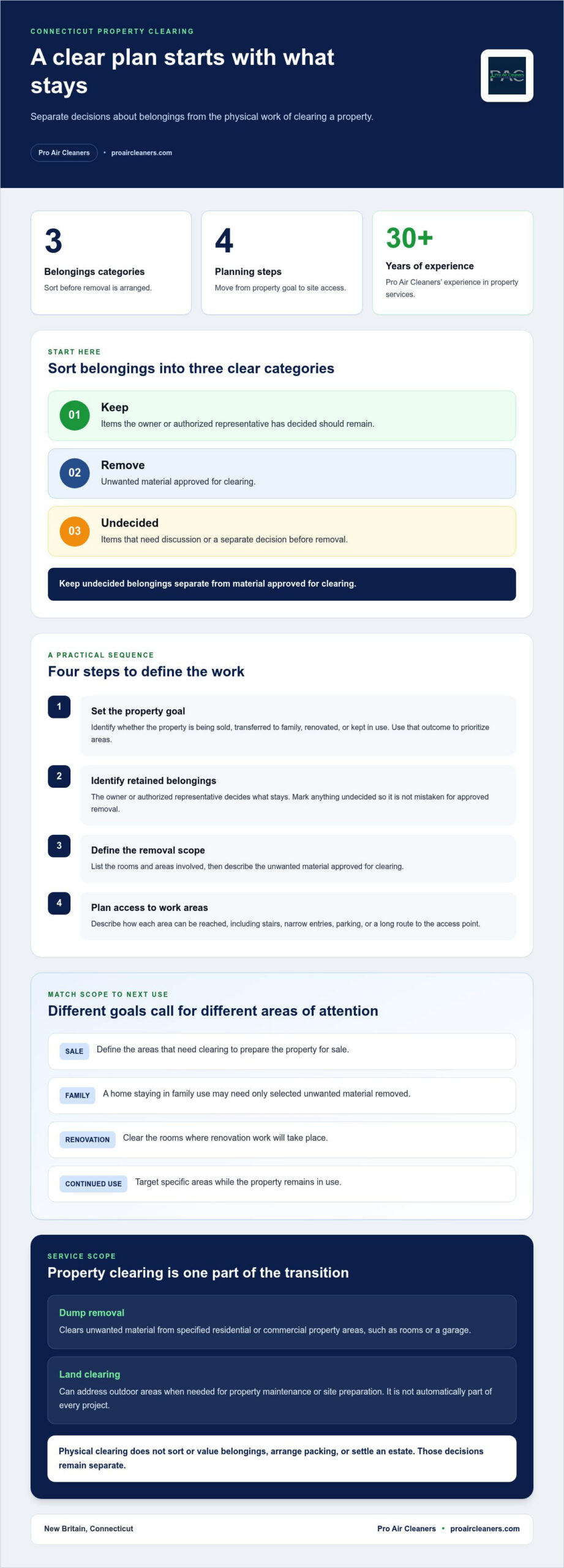
Before arranging removal, group belongings and material into three categories:
- Keep: Items the owner or authorized representative has decided should remain.
- Remove: Unwanted material approved for clearing.
- Undecided: Items that need discussion or a separate decision before removal.
This gives estate cleanout services CT a workable starting point without confusing physical clearing with sorting, valuation, packing, or estate administration. Once the property goal and removal scope are clear, identify the areas involved and describe access to them.
Planning a Connecticut Estate Cleanout: Step-by-Step
A clear plan separates decisions about belongings from the physical work of removal. Before arranging estate cleanout services CT, the owner or authorized representative should decide what stays and which areas need attention. This creates a shared scope and helps align clearing with the property’s next use.
Set the estate property’s goal before clearing begins
First, identify whether the property is being sold, transferred to family, renovated, or kept in use. That goal helps prioritize rooms, storage areas, and outdoor spaces. Record decisions before removal is arranged, and set aside anything still under discussion rather than treating it as ready to go. A written list or room-by-room notes can make instructions easier to follow.
- Set the property goal. Describe the next use in plain terms, such as preparing the interior for renovation or clearing selected areas while the home remains in use. Use that outcome to decide what needs attention first.
- Identify retained belongings. The owner or authorized representative should decide what stays before removal begins. Note items to keep and identify anything undecided so it is not confused with material approved for clearing.
- Define the removal scope. List the rooms and areas involved, then describe the unwanted material to be removed. Keep the scope focused on physical clearing. Sorting, packing, donation arrangements, valuation, and estate administration are separate tasks.
- Plan access to the work areas. Describe how each area can be reached. Note stairs, narrow entries, parking, or a long route between the items and the access point. These details help establish a practical site plan.
Define the removal scope and site access
Walk through the property and make an area-by-area list. Include interior rooms, basements, garages, yards, or other zones only when they are part of the project. A garage containing unwanted material may call for dump removal, while an outdoor area needing site preparation may involve a different scope. Listing each area separately helps clarify what the work covers.
Keep decisions about selling or liquidating belongings separate from removal planning. The Professional Standards in Estate Liquidation resource provides background on the distinct field of estate liquidation. Separating these tasks helps prevent the removal plan from being mistaken for item pricing, sales, or settlement of the estate.
Set the property goal, decide what stays, define what gets removed, then describe access to each work area. This sequence creates a clear starting scope without assuming a particular completion date. If unwanted material or exterior areas are part of the plan, explore property-clearing services as part of preparing the site.
How to Compare Estate Cleanout Plans by Property Goals and Scope
A useful comparison starts with the property’s next use, not a preset list of cleanout tasks. The rooms involved, the type of unwanted material, access, and decisions about belongings all shape the scope. This helps separate physical removal from decisions about sales or estate paperwork, which remain with the owner or authorized representative.
Property goal: Prepare for sale
Areas involved: Spaces identified for clearing as the property moves toward its next stage.
Removal scope: Unwanted material in those specified areas.
Decisions still needed: Which belongings stay and which are approved for removal.
Property goal: Transfer to family
Areas involved: Rooms or storage areas relevant to the family’s intended use.
Removal scope: Material the owner or representative has chosen not to retain.
Decisions still needed: Agreement on belongings being kept or left for the next occupant.
Property goal: Renovate
Areas involved: Rooms or work areas that need to be cleared for the planned project.
Removal scope: Unwanted contents identified for removal before renovation work proceeds.
Decisions still needed: Which items are retained and what work belongs to the renovation itself.
Property goal: Continue using the property
Areas involved: Selected rooms, garage, yard, or other zones chosen for clearing.
Removal scope: Unwanted material in those areas, rather than a whole-property clearout by default.
Decisions still needed: What can be removed without affecting ongoing use.
Match the cleanout scope to the property’s next use
For a planned sale, focus on the spaces that need clearing for the next stage instead of assuming every room must be emptied. A family transfer may call for a different approach, especially if furnishings or stored items will remain for the new occupant. If the property will stay in use, a targeted scope can preserve usable areas while addressing specific accumulation.
Renovation also calls for a clear distinction between contents to be removed and construction or demolition work. Dump removal can address unwanted material approved for clearing; it does not include altering the building or completing renovation work. Defining that boundary helps keep the removal plan focused.
Compare removal needs without confusing them with estate administration
Dump removal addresses unwanted material, not appraisals, sales, or legal paperwork. Those decisions remain separate from the physical clearing plan and with the people responsible for them. If exterior maintenance or site preparation is part of the property goal, land clearing may also be relevant. It is not necessary for every estate cleanout.
A useful cleanout plan begins with clear scope, not assumptions. As you compare estate cleanout services CT, match the areas and material requiring removal to the property’s intended use. Keep personal and legal decisions distinct from the physical work.
Prepare for Estate Cleanout Services in CT with This Practical Checklist
Preparation makes the removal scope easier to explain and helps reduce uncertainty during a property transition. Before arranging estate cleanout services CT, gather the decisions and site details that define the work. You do not have to resolve every question at once, but belongings not approved for removal should be clearly set apart.
Organize decisions about belongings and rooms
Start with the owner’s or authorized representative’s instructions. Mark what must remain, what is approved for removal, and what still needs a decision. Then identify the rooms or outdoor areas that matter most to the property’s next use. This keeps the requested work focused instead of assuming that every space needs clearing.
- Keep: Record belongings that must stay, including items in rooms where removal is planned.
- Remove: Note unwanted material approved for physical clearing.
- Undecided: Separate items requiring further discussion so they are not mistaken for removal items.
- Priority areas: List the rooms, garage, yard, or other zones that need attention first, based on the intended outcome.
- Property goal: Write down whether the home is being sold, transferred, renovated, or kept in use, and include that outcome in the scope.
Keep the list practical. Room-by-room notes can show which areas are involved and where belongings should not be disturbed. If multiple people are involved in decisions, make sure the instructions reflect the owner’s or authorized representative’s direction before planning physical removal.
Make the property ready for a clear removal plan
Next, record conditions that affect access to the areas on your list. These details help describe the property accurately and keep the plan focused on the work involved.
- Identify entry points and note narrow doorways, stairs, or other access constraints.
- Describe available parking and the route from the access point to the items being removed.
- Specify whether the work concerns indoor areas, outdoor areas, or both.
- Distinguish dump removal of unwanted material from land clearing for exterior maintenance or site preparation.
- Note town-specific disposal or permit questions that may apply to the planned work, and verify local requirements before making arrangements.
In Connecticut, local requirements can depend on the municipality and the type of material or work involved. Do not assume one town’s process applies throughout the state. Keep disposal or permit details specific to the property’s location and project.
These notes make it easier to describe the requested scope in terms of the property’s actual needs. Pro Air Cleaners provides dump removal and land clearing for property maintenance and site preparation. Discuss your Connecticut property-clearing needs as you plan the next steps.
Plan Your Connecticut Estate Cleanout with Pro Air Cleaners
Once the property’s goal and the areas needing attention are clear, match the physical work to the site. Pro Air Cleaners provides dump removal and land clearing to support specific property-clearing needs during an estate transition. Based in New Britain, Connecticut, the company serves residential and commercial customers across Connecticut, Massachusetts, and New York, and brings more than 30 years of experience to its work.
Keeping the scope specific helps set clear expectations. Property clearing focuses on the unwanted material and areas identified for work. Decisions about belongings, estate paperwork, valuations, and sales remain separate, so you can plan the physical clearing without treating it as estate administration.
Where dump removal or land clearing may fit
Dump removal may fit when unwanted material needs to be cleared from a home, garage, or another part of the property. Start by identifying which areas need attention and what material has been approved for removal. This keeps belongings the owner intends to keep, or has not yet decided about, outside the removal scope.
Land clearing may fit when exterior areas need attention for property maintenance or site preparation. It can be relevant alongside interior clearing when the property’s next use depends on both, but an outdoor scope is not necessary for every cleanout. Identify exterior areas separately so the work reflects the site and its intended use.
Take the next step with a clear project outline
A short outline gives the project discussion a practical starting point. Before discussing estate cleanout services CT, gather the main details and distinguish property-clearing work from decisions that belong to the owner or estate representative. Include information that helps explain the requested work, such as access considerations and priority areas.
- Property goal: Note whether the property is being sold, transferred, renovated, or kept in use.
- Areas involved: Identify the rooms, garage, yard, or other zones that need clearing.
- Removal needs: Describe unwanted material approved for dump removal, and note whether exterior land clearing is part of the property’s needs.
- Access details: Record relevant conditions such as stairs, narrow entries, parking, or the distance to items.
A defined scope helps focus the conversation on the work itself. You do not need to settle every personal or estate decision before describing the physical clearing. The outline also makes it easier to identify priority areas and the outcome you are preparing for.
Discuss your property-clearing project with Pro Air Cleaners
Take the Next Step Toward a Clearer Property
A property transition can feel more manageable when the next decision is specific. Start by identifying the areas that need clearing for the property’s next use, then make sure the owner or authorized representative has approved what may be removed. This provides direction without requiring every estate decision to be settled at once.
As you consider estate cleanout services CT, keep the project outline focused on the physical work: which areas need attention, what unwanted material is involved, and whether exterior clearing is part of the plan. A clear scope can turn a difficult transition into a series of practical steps.
Discuss your Connecticut property-clearing project with Pro Air Cleaners and take a practical step toward preparing the property for what comes next.
Frequently Asked Questions
How much do estate cleanout services cost in CT?
The project scope determines the type of clearing needed, so there is no single cost that applies to every estate cleanout. Property size, the amount and type of material, access conditions, and the areas involved all affect the work. Clearing unwanted material from a garage, for example, is a different scope from addressing both a garage and an exterior area. Describe the property and the areas requiring clearing to start a focused project discussion.
How long does an estate cleanout usually take?
Timing varies with the amount of material, property layout, access, and agreed scope. Clearing a few specified areas calls for different planning from addressing multiple rooms and exterior spaces. Stairs or a long route from the items to an exit can also affect the work. Identify priority areas and belongings that must remain before removal is arranged. Clear instructions help shape the plan, but do not establish a guaranteed completion window.
Can estate cleanout services include a garage, basement, or yard?
Those areas can be included when they are part of the project scope, but they are not automatically included in every cleanout. Pro Air Cleaners provides dump removal for unwanted material and land clearing for exterior needs such as site preparation or property maintenance. Specify whether the garage, basement, yard, or another area needs attention, and describe the property’s intended use so the work reflects its needs.
What happens if family members disagree about what to remove?
Pause removal decisions for disputed belongings until the estate’s authorized decision-makers resolve them. In the meantime, keep those items separate from material clearly identified as unwanted. A simple “undecided” label on an item, box, or room can help prevent confusion during planning. Include only areas and material approved for clearing in the removal scope so unresolved family decisions are not mistaken for permission to remove belongings.
Do estate cleanout services sort belongings or arrange donations?
Sorting belongings and arranging donations are separate from physical removal. Before planning removal, the owner or authorized representative should identify what stays, what may go, and what remains undecided. This is especially useful in mixed storage areas, where personal keepsakes may be alongside unwanted material. Pro Air Cleaners provides property-clearing services, including dump removal. Decisions about sorting, packing, valuing, selling, or donating belongings should be handled separately.
Can an estate cleanout help prepare a Connecticut property for sale or renovation?
Clearing unwanted material can be one part of preparing a Connecticut property for sale or renovation. Identify which rooms or outdoor areas need clearing and what material is approved for removal. Pro Air Cleaners’ dump removal can address unwanted material, while land clearing may fit exterior site-preparation needs. These services are distinct from renovation, demolition, real-estate preparation, and legal work, so define the clearing scope clearly.
Does Pro Air Cleaners serve estate cleanout customers outside New Britain?
Pro Air Cleaners is based in New Britain and serves residential and commercial customers across Connecticut, Massachusetts, and New York. The company provides dump removal and land clearing for property needs. To discuss a project, describe the property location, the areas needing attention, and whether the work involves unwanted material, exterior clearing, or both.