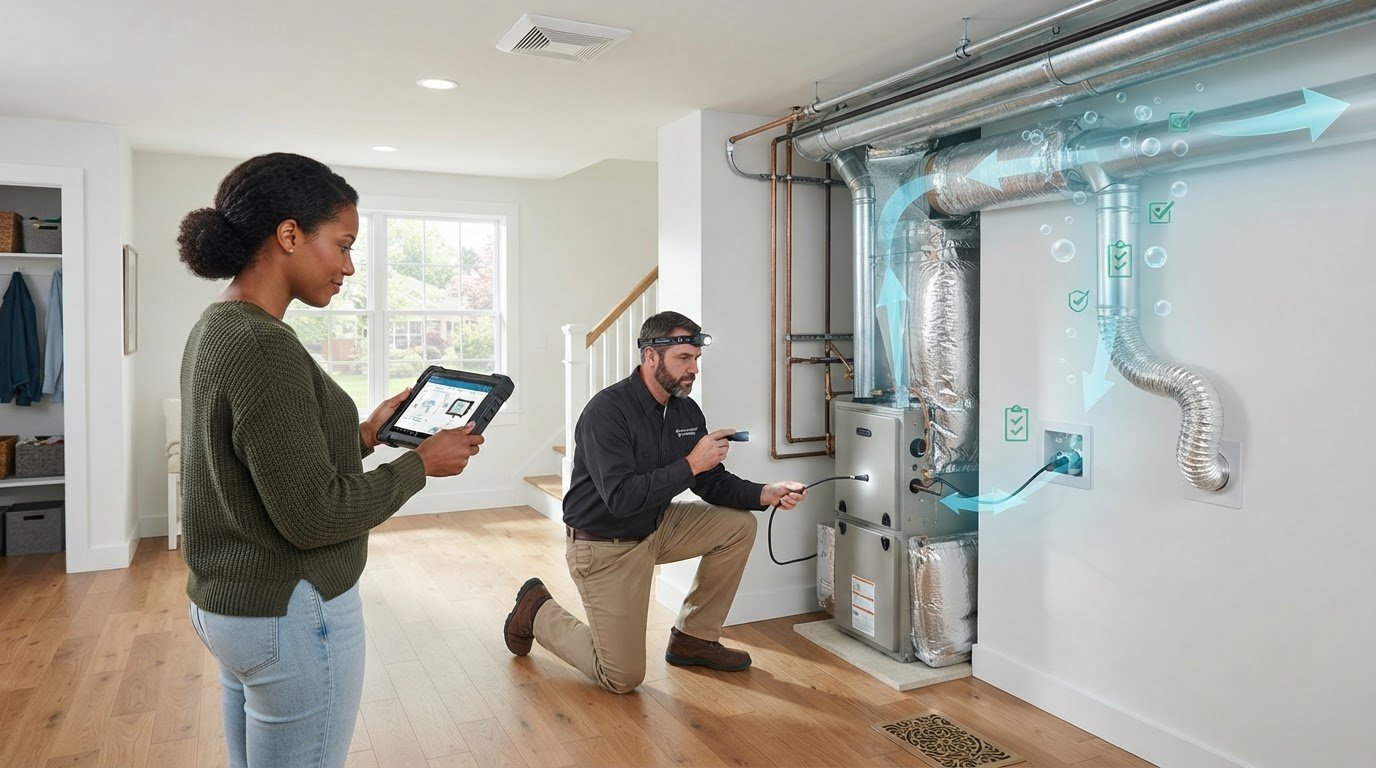
After getting the keys, first find out what each vent serves and what maintenance was completed before you arrived. Without reliable records, vent cleaning for new homeowners can feel like guesswork, especially when HVAC registers, dryer exhausts, and bathroom vents are easy to confuse.
You don’t need to clean every vent simply because you’ve moved in. A careful first inspection can help you spot visible buildup or damage, identify systems that need closer attention, and avoid overlooking a maintenance or safety concern.
Use this checklist to map your home’s ventilation, look for signs that warrant further inspection, and gather any maintenance history you can find. You’ll also learn when a professional assessment may help answer questions and how to plan care for your air ducts, dryer vent, and bathroom ventilation during your first year.
Key Takeaways
- Use a first-week walkthrough to locate vents, filters, and exhaust outlets, then note what each appears to serve.
- Learn how air ducts, dryer vents, and bathroom exhausts differ. A visible register can’t show the condition of the full duct network.
- With vent cleaning for new homeowners, look for specific signs that call for closer attention rather than assuming every system needs immediate cleaning.
- Start a maintenance log with each system, your observations, the date, and a next action guided by manufacturer instructions.
- If records or visible conditions leave questions, ask a professional to explain the findings and the scope of any recommended work.
Vent cleaning for new homeowners: start with a first-week walkthrough
If the home’s ventilation service records are incomplete, you may not know what’s been cleaned, repaired, or replaced. Use your first week to map what you can see and collect available paperwork. For vent cleaning for new homeowners, this walkthrough provides a starting point without assuming that missing records mean a system was neglected.
Which vents and exhaust outlets should a new owner locate?
Walk through each room and note visible registers and fans. This helps you identify systems, but it won’t reveal the condition of hidden ductwork or confirm where every exhaust duct leads. For background on how natural and mechanical ventilation work together, Understand your home’s ventilation.
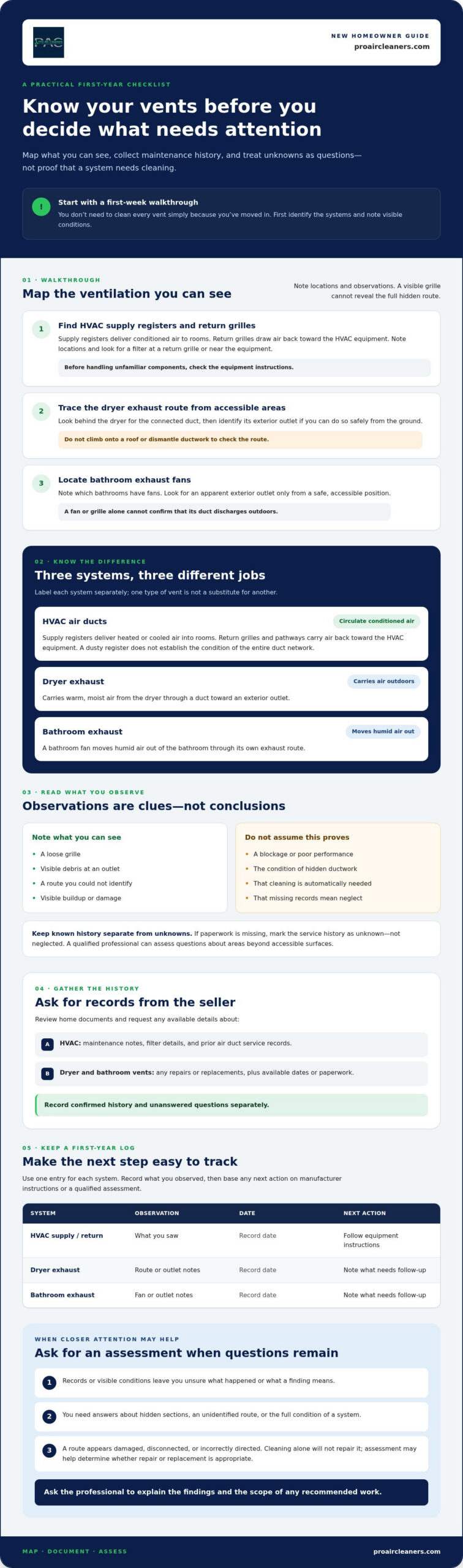
- Find supply registers and return grilles. Supply registers deliver conditioned air to rooms; return grilles draw air back toward the HVAC equipment. Note their locations and look for a filter at a return grille or near the equipment. Check the equipment instructions before handling unfamiliar components.
- Trace the dryer exhaust route from what’s accessible. Look behind the dryer for the connected duct, then identify its exterior outlet if you can do so safely from the ground. Don’t climb onto a roof or dismantle ductwork to check the route.
- Locate bathroom exhaust fans. Note which bathrooms have fans and look for an apparent exterior outlet from a safe, accessible position. A visible fan or grille alone can’t confirm that the duct discharges outdoors.
Record what you see, such as a loose grille, visible debris at an outlet, or a route you couldn’t identify. These are observations, not proof of a blockage, poor performance, or a need for cleaning. A qualified professional can assess questions that require examining parts of the system beyond accessible surfaces.
What records should you request from the seller?
Review the home documents and ask the seller for available HVAC maintenance notes, filter details, and prior air duct service records. Ask whether dryer vent or bathroom vent repairs or replacements were completed, and whether dates or paperwork are available. Keep the answers with your walkthrough notes so confirmed history is separate from what remains unknown.
If paperwork is missing, mark the service history as unknown rather than labeling it neglected. This gives you a clear basis for follow-up if visible conditions raise questions. Identify each system before deciding whether to schedule cleaning.
Understand your home’s air ducts, dryer vent, and bathroom exhaust
The vents around your home may look alike, but they serve different systems. Knowing which one you’re looking at helps you describe a concern clearly and avoid treating one type of vent as a substitute for another. A visible grille is only an access point, not a complete view of the duct or exhaust route behind it.
How do HVAC air ducts work in a home?
Supply registers deliver heated or cooled air into rooms. Return grilles and other return pathways carry air back toward the HVAC equipment, supporting circulation through the home. Together, these components make up the air distribution system.
Dust around one register may come from the room or collect at the opening. It doesn’t establish the condition of the entire duct network. The U.S. Environmental Protection Agency explains when cleaning may be appropriate in its guidance from the EPA, which can help you assess a specific concern instead of assuming every home needs immediate duct cleaning.
How are dryer and bathroom vents different?
A dryer vent carries warm, moist air from the appliance through a duct toward an exterior outlet. A bathroom exhaust fan moves humid air out of the bathroom through its own exhaust route. These systems don’t circulate conditioned air through the home like HVAC ducts, so consider their condition and maintenance needs separately.
Air ducts circulate conditioned air; dryer and bathroom exhaust vents carry air out of the home for different reasons. If a route appears damaged, disconnected, or incorrectly directed, cleaning alone won’t repair it. The duct path may need assessment and, as appropriate, repair or replacement.
For your vent cleaning for new homeowners checklist, label each system separately: HVAC supply and return, dryer exhaust, and bathroom exhaust. Record what you can observe, but leave conclusions about hidden sections or the full route to a qualified professional. This makes it easier to ask focused questions if you notice a specific concern.
If your walkthrough raises a question about a particular system, review air duct and exhaust vent services to understand what help may be relevant.
Use these signs to decide whether a vent needs professional attention
A new home doesn’t automatically need every duct cleaned. Missing service records are a reason to gather information, not proof that the system has been neglected. Use visible clues and changes in performance to decide what deserves a closer look, while leaving conclusions about hidden ductwork to a qualified professional.
What visible clues are worth documenting?
Check only areas you can reach safely without taking apart equipment. Note visible debris at an accessible outlet, a damaged or missing vent cover, or a section that appears disconnected, crushed, or deteriorated. These observations can guide an assessment, but they don’t confirm what’s happening inside the rest of the route.
Record the location and circumstances. For example, note which room or appliance is involved and when you notice the concern, such as during dryer use or while the HVAC system is running. Take clear photos from a safe, accessible position if they’ll help explain what you saw. Don’t enter a duct, remove unfamiliar components, or climb to reach an outlet.
When is cleaning different from repair or replacement?
Cleaning removes accumulated material from an accessible system; it doesn’t reconnect a separated section or restore a damaged duct. If a vent looks disconnected, crushed, or deteriorated, arrange an assessment to determine whether repair or replacement is appropriate. Don’t assume cleaning will solve the issue. For air duct concerns, see this air duct repair and replacement guide.
Dryer performance concerns also call for assessment, not a guess about the cause. If drying seems different than expected or you notice a concern at the exhaust outlet, record what’s happening and ask a qualified professional to evaluate the vent route. UL Solutions offers information on preventing clothes dryer fires, including the value of proper installation and maintenance. If you’re wondering whether a dryer vent needs replacement, this Connecticut dryer vent replacement guide can help you understand what to ask.
For vent cleaning for new homeowners, let a specific observation guide the next step. A professional can explain what an inspection found and whether the system needs cleaning, repair, or replacement. That helps you choose work that matches the condition instead of paying for assumptions.
Build a new-homeowner vent maintenance checklist for your first year
A simple record turns your initial walkthrough into a practical plan. Rather than assigning every vent a fixed cleaning date, track what you know, follow manufacturer instructions for filters and appliances, and update your next steps as you learn more about each system. This keeps vent cleaning for new homeowners focused on observed needs instead of guesswork.
What should your home maintenance record include?
Use a notebook or digital file and make one entry for each system. Record the system or vent, the date you checked it, what you observed, and the next action. Mark unknown details as unknown until you can confirm them.
- HVAC: Record supply and return locations, available filter information, visible observations, and any maintenance guidance in the equipment documents.
- Dryer exhaust: Note the appliance and outlet location, any visible concern, and the relevant care instructions in the appliance manual.
- Bathroom exhaust: List the fan location, what you can observe about its outlet, and any questions for a professional.
Save invoices, inspection notes, photos, and recommendations with your other home maintenance records. If work is completed, note which system was addressed and keep any repair or replacement details. Over time, this file can help you distinguish routine care from a new concern.
There’s no need to create an arbitrary schedule for every vent. Timing depends on system condition, household use, manufacturer guidance, and professional findings. Check available instructions for filter care and appliance maintenance, then ask a qualified professional whether a specific observation warrants cleaning or another step.
How can Connecticut homeowners prepare for a service visit?
Before scheduling, confirm that the provider serves your town and ask which system is included, such as air ducts, a dryer vent, or bathroom exhaust. Share relevant access details, available service records, and the observations that prompted your inquiry. Clear information helps keep the discussion focused on the system you want assessed.
For a local overview of duct cleaning, read this guide to air duct cleaning in New Britain, CT. If your notes point to a specific air duct, dryer vent, or bathroom vent concern, review Pro Air Cleaners’ vent services and confirm availability for your town.
Know when to call a vent cleaning professional in Connecticut
Your notes can help you decide whether a concern needs a closer look. If records are incomplete, an accessible outlet shows debris, a vent cover is damaged, or a route appears compromised, contact a qualified professional and describe the specific system. The goal is to understand what’s present and what work, if any, is appropriate, not to authorize broad cleaning based on uncertainty alone.
What should you ask before scheduling vent cleaning?
Ask clear questions before agreeing to service. A defined scope helps you understand what will be addressed and compare the recommendation with your observations.
- Which system is included: air ducts, the dryer vent, or bathroom exhaust?
- What does the cleaning cover, and will the provider explain what they find?
- If repair or replacement is recommended, what condition supports that recommendation, and can it be explained before you authorize additional work?
- Are technicians insured, and does the provider serve your specific Connecticut town?
Share relevant photos, records, and access details. Ask the provider to distinguish visible findings from areas that need further assessment, so you can make an informed decision without relying on assumptions.
What can a professional service help assess?
Pro Air Cleaners provides air duct cleaning, dryer vent cleaning, and bathroom vent cleaning. The company also offers air duct vent repairs and replacements, along with bathroom vent replacements. If a vent appears damaged, don’t treat a cleaning visit as a substitute for addressing the condition. Ask whether the finding calls for repair or replacement and why.
Pro Air Cleaners has more than 30 years of experience and insured technicians. The company serves residential and commercial clients across Connecticut. A clear conversation about the system, the observations that prompted your inquiry, and the proposed scope can help you determine whether the relevant service fits the need.
For vent cleaning for new homeowners, professional help is most useful when it answers a specific question raised by your walkthrough or records. You can review Pro Air Cleaners’ vent services to learn about the available options.
Take the next step with confidence
A first-week walkthrough gives you a clearer picture of your home’s air ducts, dryer vent, and bathroom exhaust. A simple maintenance record helps turn observations into sensible follow-up. Visible dust or missing paperwork doesn’t automatically mean every system needs cleaning. Focus on specific signs, check manufacturer guidance for filters and appliances, and ask a professional to explain any recommended work.
For vent cleaning for new homeowners, a documented concern is a practical starting point for deciding what to do next. Pro Air Cleaners provides air duct, dryer vent, and bathroom vent cleaning, along with vent repair and replacement services. The company has more than 30 years of experience and insured technicians, and serves residential and commercial clients across Connecticut.
Contact Pro Air Cleaners about your home’s vent needs to discuss the system you’ve identified and the questions you still have. With a clear record and relevant guidance, you can build a maintenance plan for your new home.
Frequently Asked Questions
Should new homeowners have their air ducts cleaned right away?
No, moving into a new home doesn’t automatically mean the air ducts need cleaning. Missing service records are a reason to investigate, not proof of neglect. The U.S. Environmental Protection Agency doesn’t recommend routine duct cleaning solely to improve indoor air quality, but suggests considering it when there’s a specific reason, such as after renovation or a pest infestation. If you’re unsure, document what you notice and ask a qualified professional to assess it.
Which vents should I check after moving into a new home?
Start by locating the HVAC supply registers that deliver conditioned air and the return grilles that carry air back toward the system. Also find the dryer’s exhaust route and exterior outlet, plus bathroom exhaust fans and any outlets you can identify safely. These systems serve different purposes, so record them separately. Don’t climb onto a roof or take apart equipment to trace a vent; note any route you can’t confirm.
How can I tell if my dryer vent needs cleaning?
Look for observable changes, such as longer-than-usual drying, visible lint at an accessible outlet, or a vent cover that appears damaged. These clues don’t confirm the cause, since appliance or vent issues can have different explanations. Avoid dismantling the exhaust route to investigate. Note what you’ve observed and when it happens, then ask a qualified professional to assess the dryer vent if the concern persists or the route appears damaged.
Do bathroom exhaust fans need vent cleaning?
They may need attention if you see debris at an accessible outlet, notice visible damage, or have questions about where the fan’s exhaust route leads. A bathroom fan moves humid air out of the room, so its duct is separate from the home’s HVAC air ducts. Don’t assume cleaning will resolve a damaged or disconnected route. Record the fan location and concern, then ask a professional whether cleaning, repair, or replacement is appropriate.
Can I clean my home’s air ducts myself?
You can generally remove dust from accessible register surfaces and follow the manufacturer’s instructions for filter care, but that isn’t the same as cleaning the full duct network. Avoid reaching deep into ducts or taking apart HVAC equipment, since you could damage components or disturb material you can’t safely remove. For vent cleaning for new homeowners, a professional assessment can help determine whether the full system needs attention or whether a visible surface issue is limited.
How often should a new homeowner schedule vent cleaning?
There isn’t one interval that suits every vent system. The EPA doesn’t recommend routine air duct cleaning solely to improve air quality, so base decisions on the system’s condition and specific concerns. Dryer vents are generally recommended for cleaning at least once a year, with more frequent attention potentially needed for high-use households or complex routes. Check appliance and filter instructions, keep service records, and adjust your plan based on professional findings.
What should I ask a Connecticut vent cleaning company before booking?
Ask which system is included, what the service covers, and how the provider will explain inspection findings or additional recommendations. Confirm that the company serves your Connecticut town and ask about insurance. For air duct cleaning, Connecticut requires companies to hold a home improvement license through the Department of Consumer Protection, so ask for the license details and verify them with the state. Share your observations and request a clear scope before authorizing work.