
What if the reason your surfaces never stay clean isn’t a lack of effort, but a symptom of a mechanical system working against you? If you find yourself constantly asking, “why is my house so dusty?” just hours after a deep clean, you’re likely battling more than just ordinary household debris. It is incredibly frustrating to invest in expensive supplies and hours of labor only to see a fine grey film return to your furniture, often accompanied by the return of aggravated allergy symptoms. You deserve a home that feels truly restorative, not one that requires a constant, losing battle against airborne particles that seem to appear out of nowhere.
In this article, we’ll help you discover the hidden mechanical and environmental reasons dust persists in your home and how professional maintenance can finally clear the air for good. We will examine five specific culprits, including how leaky return ducts can act as vacuums for attic debris and why older housing materials naturally shed more particulate matter over time. By understanding these root causes, you can transition from a state of constant accumulation to an environment defined by lasting cleanliness, peak system efficiency, and improved respiratory wellness.
Key Takeaways
- Learn why persistent dust is often a mechanical issue rather than a cleaning failure, allowing you to stop blaming your housekeeping and start addressing the root cause.
- Understand why is my house so dusty by exploring how negative pressure in leaky ductwork draws insulation and debris from attics directly into your air supply.
- Discover the specific regional factors in the Northeast that contribute to indoor accumulation, from aging building materials to seasonal ventilation challenges.
- Identify the critical role of bathroom vent maintenance in controlling indoor humidity and preventing “sticky” dust from adhering to your home’s surfaces.
- Gain a clear roadmap for restoring your home’s air quality through professional system optimization that targets the hidden areas where dust originates.
The Dust Dilemma: Why Cleaning More Isn’t Always the Solution
Many homeowners spend hours every weekend scrubbing and polishing only to see a fine grey film return to their coffee tables by Monday morning. This cycle is incredibly discouraging, and it often leads to the persistent question: why is my house so dusty despite all my hard work? It is important to understand that a dusty home is not a reflection of your cleaning habits or personal hygiene. Instead, it is a sign that your living space has become a closed loop where particles are constantly recycled rather than removed.
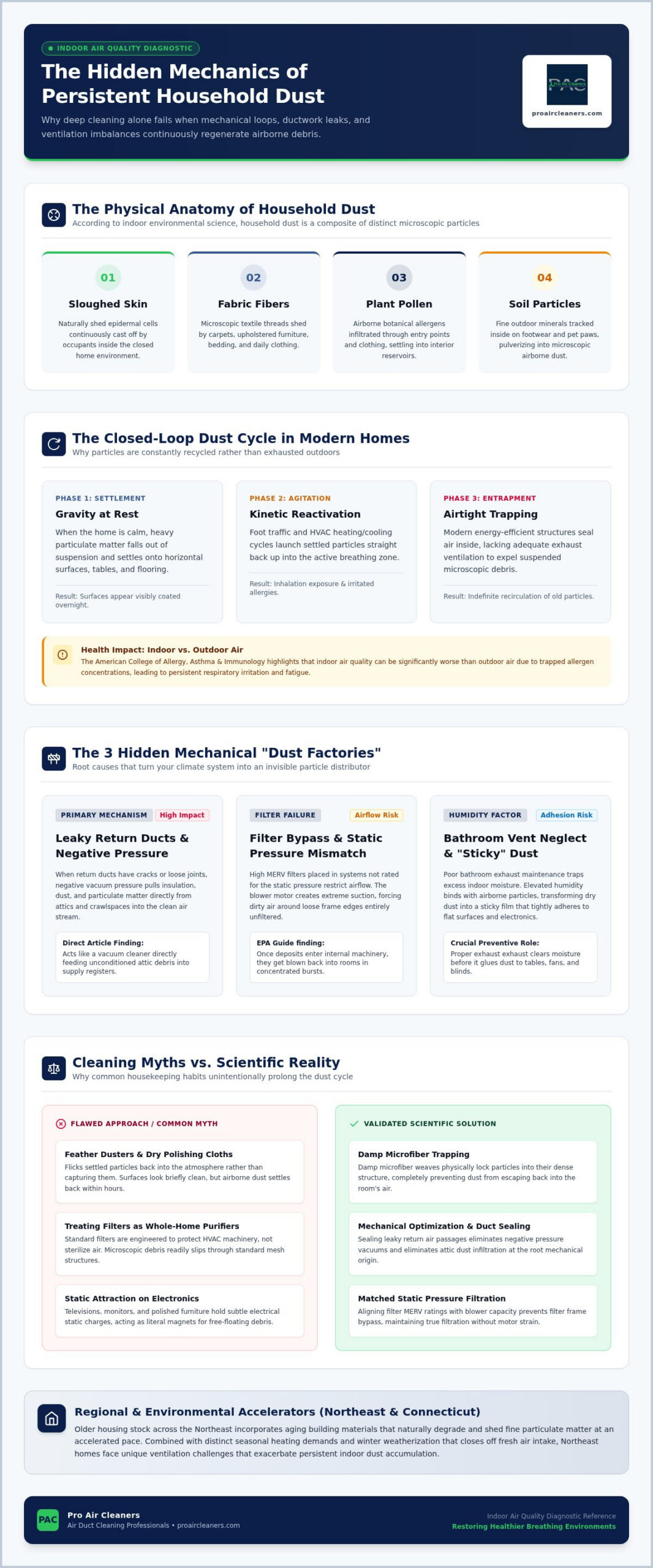
To truly answer why is my house so dusty, we must look at the physical makeup of the debris. Science shows that the composition of household dust is a complex mixture of sloughed skin cells, fabric fibers from carpets and clothing, plant pollen, and microscopic soil particles. When your home is at rest, these heavy particles settle onto flat surfaces. However, as soon as you walk through a room or your heating system engages, these particles are launched back into the breathing zone. Because modern homes are built to be airtight for energy efficiency, they often lack the necessary ventilation to exhaust these materials, leaving them to circulate indefinitely.
Myth: Dusting Surfaces Solves the Problem
Traditional cleaning methods often exacerbate the issue rather than solving it. For instance, feather dusters and dry cloths frequently flick particles into the air rather than capturing them. This creates a temporary illusion of cleanliness, but those same particles eventually settle right back where they started. Additionally, electronic devices and polished furniture often carry a slight static charge, which acts as a literal magnet for airborne debris. To truly remove these materials, you should use damp microfiber cloths that trap particles within the fibers, preventing them from escaping back into the room’s atmosphere.
Understanding the Health Stakes of Indoor Dust
While the visual nuisance of dust is frustrating, the impact on your physical well-being is the primary concern. The American College of Allergy, Asthma & Immunology highlights that indoor air quality can be significantly worse than outdoor air, primarily due to the concentration of allergens trapped inside. Breathing in fine particulate matter over long periods can lead to persistent respiratory irritation and fatigue. This is why investing in air duct cleaning for allergies is a vital component of a restorative home maintenance strategy. By removing the source of the accumulation, you protect your family’s health and ensure your home remains a sanctuary of clean air.
Your HVAC System: The Invisible Dust Distributor
If you find yourself constantly cleaning surfaces only to see them coated again within hours, the central hub of your home’s climate control is likely the culprit. Think of your HVAC system as the “lungs” of your property; it is designed to inhale air from every room, condition it, and exhale it back out. When these internal components become coated with debris, the system stops being a purifier and starts acting as an active distributor. This mechanical cycle is often the hidden answer to the question: why is my house so dusty even when the windows are closed and the floors are vacuumed.
One common misconception is that a high-efficiency filter alone can solve the problem. While a high MERV rating sounds beneficial, it can actually cause more harm if your system’s blower motor isn’t rated for the associated static pressure. In many cases, these thick filters restrict airflow so significantly that the system creates “filter bypass.” This occurs when the vacuum pressure becomes so strong that air is sucked around the edges of a poorly fitted filter frame, allowing unfiltered, dusty air to enter the sensitive internal machinery. According to the EPA guide on air duct cleaning, once these deposits enter the system, they can be released into your living areas in heavy concentrations.
How Air Filters Fail (Even When They Look Clean)
Air filters are primarily designed to protect the HVAC equipment rather than act as a whole-home air purifier. While they capture large debris like hair and carpet fibers, microscopic dust often passes straight through the mesh. If you notice a dark line of dust around the edges of your filter frame, you’re likely experiencing “blow-through” where the seal has failed. To ensure your system is actually capturing particles, you should verify the following:
- The filter fits snugly without gaps between the cardboard and the metal housing.
- The gasket or foam seal around the filter door is intact and airtight.
- There are no visible “whistle” sounds, which indicate air escaping through gaps.
The Role of the Blower Fan in Dust Circulation
The blower fan is the engine of your ventilation, but it is also a magnet for fine particulate matter. Over time, dust builds up on the leading edges of the fan blades, which changes the aerodynamics of the motor and forces it to work harder. This buildup eventually becomes brittle and breaks off in microscopic shards, spraying a fine mist of debris into your ductwork. Blower contamination is a primary cause of rapid dust return because it allows a thick layer of debris on the fan blades to be pulverized and sprayed into the airstream every time the system cycles on. Simply changing a filter cannot address this internal accumulation; it requires professional air duct cleaning to restore the system to peak performance and stop the cycle of distribution.
Leaky and Dirty Ductwork: The #1 Hidden Dust Factory
While the HVAC unit acts as the lungs, the ductwork functions as the circulatory system; any breach in this network invites contamination directly into your living space. If you’re wondering why is my house so dusty, the answer often lies within the dark, unsealed passages behind your walls. When return ducts pass through unconditioned spaces like attics or crawlspaces, they operate under negative pressure. This means any gap or loose joint acts like a vacuum, sucking in fiberglass insulation, pest detritus, and fine particulate matter before blasting it through your vents.
It’s a common myth that new construction is immune to these issues. In reality, many homeowners move into brand new properties only to find the ducts filled with drywall dust, sawdust, and masonry debris left behind by contractors. Over time, internal components like fiberglass duct board can also begin to degrade, shedding its own mineral fibers into the airstream. When combined with typical indoor humidity, this dust becomes “sticky,” clumping together and providing a fertile ground for biological growth that further compromises your home’s air quality.
Why Duct Cleaning Is Not a “Scam”
There is frequent online debate regarding the necessity of ventilation maintenance, but this often stems from a misunderstanding of the process. Professional restoration is far more than a simple vacuuming of the registers. High-quality professional air duct cleaning services utilize mechanical agitation and high-pressure HEPA collection to remove pounds of accumulated debris that a standard filter could never stop. Unlike “blow-and-go” operations that merely move dust around, a legitimate service provides visible evidence of heavy debris removal, ensuring your system’s baseline is fully reset to a clean state.
The Impact of Leaky Ductwork on Indoor Air
According to the ENERGY STAR duct sealing guide, typical homes lose 20% to 30% of the air moving through the system to leaks and poorly connected joints. When these leaks occur on the return side of the system, they pull in air from dusty basements or wall cavities, which can effectively double the volume of particles in your living area. You can often identify these leaks by looking for specific signs in your home:
- Excessive dust accumulation specifically on the walls or ceiling near supply registers.
- Whistling or rattling sounds when the blower motor is running.
- Persistent hot or cold spots in certain rooms despite the system being active.
- A noticeable increase in allergy symptoms when the heat or air conditioning cycles on.
Addressing these leaks is a critical step in solving the mystery of why is my house so dusty, as it stops the “pull” effect from the dirtiest areas of your property.
Regional and Lifestyle Factors: Why Connecticut Homes Are Dustier
Living in New England brings a specific set of environmental challenges that directly impact your indoor air quality. If you find yourself asking why is my house so dusty, you must consider the radical seasonality of the Northeast. During our long winters, we seal our homes tightly to conserve heat, which effectively traps every particle of skin dander, pet hair, and fabric fiber inside a closed loop. As the forced-air heating system cycles on, it dries out these organic materials, making them lighter and more likely to remain airborne for extended periods.
Lifestyle factors and interior finishes also play a significant role in particle accumulation. Carpets and area rugs act as massive reservoirs for microscopic debris, holding onto several times their weight in fine grit. Every time you walk across a rug, the impact of your footfall acts like a bellows, kicking settled dust back up into the breathing zone. This creates a constant cycle of resettlement and redistribution that surface vacuuming alone cannot fully interrupt, especially when your HVAC system is actively pulling those particles into the return vents.
Connecticut Seasonal Dust Triggers
The transition between seasons in Connecticut creates a unique “bio-dust” profile that is difficult to manage with standard cleaning. During the spring and summer, heavy local pollen counts find their way indoors through open windows or on clothing. Once inside, these sticky particles bond with pet dander and household fibers. During the autumn “mud season,” tracked-in soil dries into a fine mineral powder that eventually enters your ventilation system. When the heating season begins, your HVAC system distributes this accumulated seasonal cocktail throughout every room in the house.
Structural Dust Sources in Older Properties
Many properties in areas like New Britain and surrounding historic communities were built before 1960. These older homes often feature horsehair plaster walls and cellulose or mineral wool insulation that naturally breaks down over several decades. As the house settles, small gaps open between floorboards and behind baseboard trim, creating direct conduits for attic and wall-cavity dust to migrate into your living spaces. This structural deterioration is a primary driver of persistent grit in older New England homes. If you want to identify these hidden entry points and finally answer why is my house so dusty, you should schedule a professional ventilation assessment with Pro Air Cleaners to stop the flow of debris at the source.
Restoring Your Environment: A Professional Path Forward
Moving from reactive cleaning to proactive maintenance is the only way to achieve a lasting reduction in household debris. While surface dusting is a necessary habit, it only addresses the symptoms of a much larger mechanical issue. By resetting your home’s environmental baseline through professional intervention, you stop the constant recycling of particles. This shift in strategy answers the fundamental question of why is my house so dusty by targeting the source rather than the surface. Pro Air Cleaners has served as a protective steward for properties across CT, MA, and NY since 1994, bringing over 30 years of experience to every restoration project. Our team functions as a reliable veteran in the field, possessing the specialized tools and long-standing expertise necessary to handle even the most complex ventilation challenges.
The Comprehensive Professional Clean
Attempting to clean your own ductwork with household vacuums often does more harm than good. DIY methods typically lack the suction power to remove deep-seated debris, and they can accidentally dislodge compacted dust into your living areas or damage fragile duct linings. Our insured technicians utilize professional-grade agitation tools and high-powered vacuum systems that create a total negative pressure environment within your HVAC system. This thorough approach ensures that every particle of skin dander, pollen, and construction debris is captured and removed from the property entirely. When the mechanical components are restored to peak performance, the system once again functions as a purifier rather than a distributor. For a detailed look at our specialized process, you can explore our Air Duct Cleaning Services in CT.
Beyond the Main Ducts: Bathroom and Dryer Vents
True environmental restoration requires looking into the unseen areas that many property owners overlook. Bathroom vents are critical for moisture control; however, when they become clogged with lint and skin cells, the resulting humidity makes household dust “sticky.” This causes particles to bond to surfaces and grow into difficult-to-remove grime that resists standard dusting. Similarly, dryer vent cleaning is essential because lint is a primary component of indoor dust. A restricted dryer vent allows fine fibers to blow back into your laundry room and eventually circulate through the rest of the house. By maintaining these specialized exhaust points, you optimize your home’s mechanical efficiency and significantly reduce the volume of airborne particles. It’s a comprehensive solution for a cleaner, healthier home. You can schedule a comprehensive vent inspection with Pro Air Cleaners today to ensure every part of your ventilation system is performing at its peak.
Take Control of Your Indoor Air Environment
Persistent accumulation on your furniture is rarely a sign of poor housekeeping; instead, it’s a clear indicator that your home’s mechanical systems require professional attention. By addressing the hidden culprits like leaky return ducts and contaminated blower motors, you stop the cycle of distribution and finally resolve the question of why is my house so dusty. Your ventilation system acts as the lungs of your property, and keeping those pathways clear is essential for both mechanical efficiency and your family’s long-term wellness.
Pro Air Cleaners brings over 30 years of local Connecticut expertise to every project, providing the peace of mind that comes from working with a seasoned team of specialists. Our fully insured technicians utilize specialized equipment for deep-vent restoration, ensuring that even the most stubborn debris is safely removed from your living space. You deserve a home that feels truly restorative and clean. To begin your transition from a state of accumulation to one of optimal function, Request a Professional Air Quality Consultation and Duct Inspection today. We’re ready to help you clear the air and reclaim your home environment.
Frequently Asked Questions
Is it normal for a house to be dusty every day?
It isn’t normal for heavy layers of dust to reappear within twenty-four hours of a thorough cleaning. While some settling is natural in any living space, rapid accumulation usually indicates a mechanical failure in your ventilation system or a breach in the building envelope. In many Connecticut homes, this is caused by return ducts pulling in debris from unconditioned spaces like attics or basements, requiring professional intervention to restore air quality.
Can dirty air ducts make my house dusty?
Dirty air ducts are a primary reason homeowners ask why is my house so dusty despite their best cleaning efforts. Over years of operation, your ductwork accumulates thick layers of skin cells, fabric fibers, and outdoor particulates that your filter missed. When the HVAC system cycles on, these deposits are blown through the supply vents and distributed across every surface, creating a cycle where the house never feels truly clean.
Does duct cleaning actually reduce the amount of dust in a home?
Professional duct cleaning significantly reduces indoor dust by removing the source of the accumulation from the interior of your ventilation system. By using high-powered vacuums and mechanical agitation, technicians extract pounds of debris that would otherwise circulate through your rooms. This process resets your home’s air quality baseline, allowing your filters to function more efficiently and ensuring that your furniture stays noticeably cleaner for longer periods between chores.
How often should I have my air ducts professionally cleaned in CT?
Industry standards generally recommend a comprehensive cleaning every three to five years for most residential properties. However, many homeowners in Connecticut opt for a shorter interval of two to three years if they have shedding pets, active allergy sufferers, or live in historic homes built before 1960. Regular inspections ensure that your system isn’t working against your cleaning efforts, maintaining both your property’s value and your family’s respiratory health.
Why is there so much dust in my bedroom specifically?
Bedrooms often accumulate more debris because they are high-traffic areas filled with soft textiles like bedding and curtains that shed fibers. If you’re asking why is my house so dusty specifically in the sleeping quarters, it may indicate that the local duct run is leaking or that the room lacks sufficient air return. This causes particles to settle on surfaces rather than being drawn into the filtration system for removal.
Can a high-efficiency air filter actually make my house dustier?
A high-efficiency filter can indirectly increase dust levels if it isn’t properly matched to your system’s blower capacity. If a filter is too restrictive, it can cause “filter bypass,” where the system’s suction pulls unfiltered air through gaps around the filter frame. This allows raw dust to enter the ductwork and bypass the filtration process entirely. Ensuring a proper fit and using the correct MERV rating is vital for maintaining a restorative environment.
What is the best way to remove dust from the air, not just surfaces?
The most effective way to clear airborne dust is to optimize your home’s mechanical filtration and ventilation systems. While portable air purifiers help in single rooms, a professionally cleaned and sealed duct system ensures that your entire home’s air is filtered multiple times per hour. This mechanical restoration prevents particles from remaining airborne long enough to settle on your furniture or aggravate your allergy symptoms, providing a more comprehensive solution for wellness.
Does a clogged dryer vent contribute to household dust?
A clogged dryer vent is a major contributor to lint accumulation, which is a significant component of household dust. When the exhaust pipe is restricted, fine fabric fibers are forced back into the laundry room and eventually spread through the rest of the house. Professional dryer vent cleaning prevents this backflow, ensuring that lint is exhausted safely outside while also improving your appliance’s efficiency and reducing potential fire hazards in your home.