A duct cleaning appointment can affect far more than the appearance of your vents. The company working inside your ductwork may influence the air your family breathes, the efficiency of your HVAC equipment, and whether hidden issues such as damaged ducts, moisture, or heavy buildup are identified early. Knowing how to choose a duct cleaning company helps you avoid rushed, surface-level service and hire a team equipped to do the job properly.
The lowest advertised price is rarely the full story. A professional cleaning requires trained technicians, specialized negative-air equipment, HEPA filtration, careful access to the HVAC system, and a process for confirming results. Whether you manage a commercial building or own a home in Connecticut, Massachusetts, or New York, look for clear evidence that the company protects both your indoor environment and your equipment.
How to Choose a Duct Cleaning Company With Confidence
Start by asking what the company actually cleans. Some providers use a basic vacuum at the register and call it duct cleaning. That may remove loose dust near the vent opening, but it does not address buildup farther inside supply and return ducts, the blower compartment, coils, or other accessible HVAC components.
A qualified company should explain its process in plain language. It should be able to describe how technicians create controlled suction through the system, agitate debris from duct surfaces, contain dust during the work, and protect your home or business while equipment is in use. The answer should be specific to your property, not a vague promise to “clean every vent.”
Ask whether the company offers a visual inspection before work begins. Video inspections are especially useful because they give you a clearer picture of conditions inside areas you cannot normally see. They also help establish whether cleaning is appropriate, whether a duct has become disconnected or damaged, or whether a vent repair should be handled before cleaning.
Look for specialized equipment, not household tools
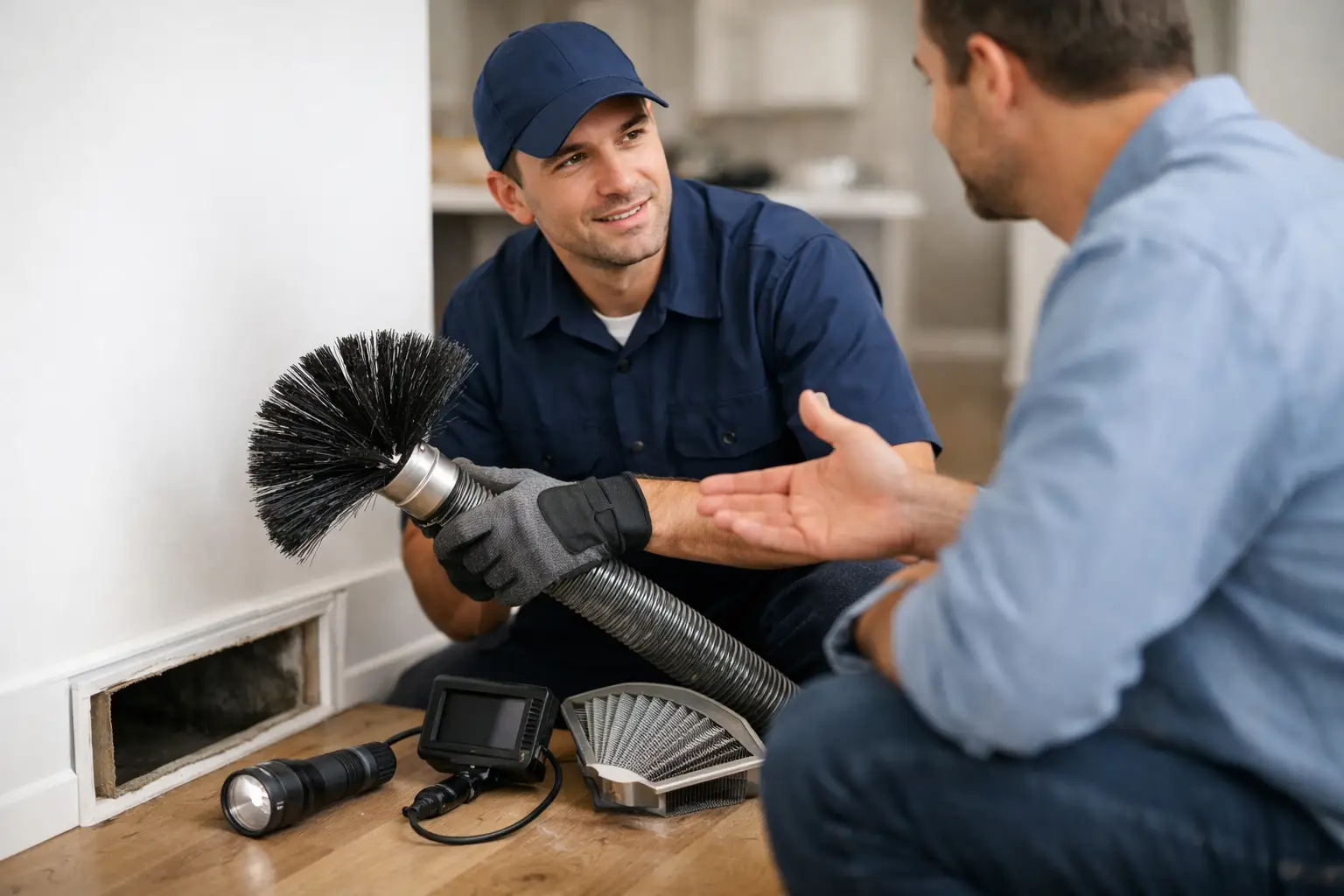
Ductwork is a closed system with long runs, turns, joints, and branches. Effective cleaning requires equipment designed to reach and remove debris from those areas without releasing it back into the building. HEPA-filtered collection equipment is a meaningful sign that the provider takes containment seriously, particularly in homes with children, pets, allergies, asthma, or dust sensitivity.
Ask what equipment the crew will bring and how they prevent dust from spreading. A reputable answer may include negative-air machines, agitation tools, HEPA filtration, protective coverings, and access methods appropriate for your system. The exact setup depends on the building and duct design, but the company should have a method that is more thorough than simply inserting a hose through each vent.
Be cautious when a provider refuses to explain its equipment or says that all duct systems can be cleaned the same way. Flexible ducts, older ductwork, sheet-metal systems, and commercial HVAC systems may require different approaches. The right company adapts the service without compromising the duct material or the HVAC system.
Verify experience, training, and insurance
Duct cleaning involves working around expensive heating and cooling equipment, electrical components, ceilings, walls, and access panels. Experience matters because technicians need to recognize what is normal, what is damaged, and when an issue should be documented rather than ignored.
Ask how long the company has been serving customers and whether its technicians are trained specifically in air duct and vent cleaning. A provider with substantial field experience is more likely to understand airflow, contamination concerns, access limitations, and the difference between a cleaning need and a larger HVAC or repair issue.
Insurance is just as practical. Confirm that the company is insured before allowing work in your home, rental property, office, restaurant, or facility. This protects you if accidental damage occurs and signals that the provider treats the work as a professional service, not a quick side job.
For commercial properties, also ask whether the company can coordinate around tenant schedules, business hours, building access requirements, and areas that must remain clean or operational. A dependable contractor understands that clean air and uninterrupted operations often need to happen together.
Expect transparent pricing and a defined scope of work
A low price can be tempting, especially when a coupon promises whole-house cleaning for an unusually small amount. However, vague pricing often leads to pressure tactics after the technician arrives. You may be told that every return, main line, or HVAC component costs extra, even though those items are central to a complete service.
Request a written estimate that explains what is included. It should identify the number of systems or zones covered, the supply and return ducts to be serviced, accessible HVAC components, inspection steps, and any additional services that may be recommended. If the property has multiple air handlers, difficult access, extensive contamination, or damaged vents, the final cost may reasonably vary. What matters is that the company explains why.
A trustworthy provider does not need to create urgency through fear. If technicians find mold-like growth, rodent activity, damaged duct insulation, a disconnected line, or another concern, they should show you the evidence, explain the options, and tell you what needs prompt attention versus what can be planned.
Ask how the company proves the work was completed
Duct cleaning is not always easy for a customer to verify from the living room. That is why pre- and post-cleaning documentation is valuable. Before-and-after photos or video can show accessible duct interiors, registers, and system conditions more clearly than a verbal assurance alone.
Post-cleaning inspection practices should also be part of the conversation. A company that follows EPA-standard cleaning and inspection principles will focus on removing visible debris, controlling contamination, and checking the system rather than treating the job as a fast pass through the vents. No honest contractor should promise that duct cleaning will cure every allergy problem or solve unrelated HVAC issues. Indoor air quality depends on several factors, including filtration, humidity, outdoor pollutants, housekeeping, and the condition of the system itself.
Still, a thorough cleaning can make a meaningful difference when dust, construction debris, pet hair, odors, or other buildup is present. It can also help HVAC equipment move air more efficiently when accessible components and airflow pathways are properly maintained.
Pay attention to safety practices and cleaning products
Ask whether the company uses chemicals, deodorizing products, or antimicrobial treatments. These products are not automatically necessary for every cleaning, and they should never be applied without your knowledge. If a treatment is recommended, the company should explain the reason, where it will be used, and whether it is appropriate for occupants, pets, and the duct material.
For many households and workplaces, green, baby-safe solvents are a better fit when a cleaning solution is genuinely needed. The goal is not a strong fragrance that masks an odor for a few days. The goal is to identify the cause of the odor and address it safely, whether that means cleaning buildup, repairing a vent, correcting moisture conditions, or recommending another qualified service.
Safety should extend to dryer vents and bathroom exhaust vents as well. Lint-clogged dryer vents can raise fire risk and increase drying times. Bathroom vents that are blocked, undersized, or venting improperly can contribute to lingering moisture and mold concerns. A company with real vent experience can inspect these systems as part of a broader property maintenance plan.
Check reviews for details, not just star ratings
Online reviews can be helpful, but read beyond the overall score. Look for comments about punctuality, cleanliness, communication, respect for the property, clear estimates, and visible results. For commercial clients, reviews mentioning scheduling coordination and reliable follow-through can be particularly useful.
A few negative reviews do not automatically rule out a company. What matters is the pattern and how the business responds. Repeated complaints about surprise charges, incomplete work, aggressive upselling, or missed appointments should be taken seriously. Consistent feedback about knowledgeable technicians and straightforward communication is a stronger sign than a polished advertisement.
Choose a company that can address the full problem
Sometimes dirty ducts are only part of the issue. A crushed dryer vent, leaking duct connection, damaged bathroom fan vent, or neglected mini split can continue affecting comfort and air quality after a cleaning. Choosing a provider that can inspect, clean, repair, or replace relevant vent components can save time and prevent a partial solution.
At Pro Air Cleaners, trained technicians use professional equipment, HEPA-filtered methods, and video inspections to give homeowners and businesses a clearer view of their duct and vent conditions. With more than 30 years of experience, the focus is on cleaner indoor air, safer vent performance, and practical recommendations based on what your property actually needs.
Before you schedule, ask for a free estimate, request an inspection plan, and make sure you understand exactly what will happen in your system. The right duct cleaning company will not make you guess. It will give you clear answers, documented work, and greater confidence in the air moving through your home or business.