Around 20% of clothing lint slips past your dryer’s internal lint trap during every single cycle, quietly accumulating inside hidden duct runs where standard DIY brush kits often pack it into dangerous blockages. If your laundry now requires multiple cycles to finish and monthly power bills are creeping upward, you’re not alone in feeling uneasy about the fire risk tucked behind your drywall. Investing in professional dryer vent cleaning resolves that frustration at the root, approaching exhaust care as thorough mechanical restoration rather than a quick surface sweep.
A comprehensive cleaning restores critical airflow across multi-elbow ductwork, cuts sluggish laundry routines back to an efficient 45 minutes, and protects your household air quality from trapped moisture and heat. It also provides genuine peace of mind by eliminating the leading cause of home appliance fires. In this guide, you’ll discover how specialized diagnostic equipment, commercial rotary tooling, and NFPA safety standards work together to keep your property safe and running at peak performance.
Key Takeaways
- Understand why professional dryer vent cleaning provides complete mechanical debris extraction that routine lint trap cleaning simply cannot match.
- Identify early operational warning signs of severe duct restrictions, such as prolonged drying cycles and unusually hot appliance surfaces.
- Learn the hidden risks of consumer DIY drill kits, including punctured ductwork and disconnected rods trapped behind finished drywall.
- Discover the diagnostic stages of a specialized service, from baseline static pressure assessments to commercial rotary brush sweeping.
- Establish a reliable maintenance schedule tailored to your household size, laundry habits, and specific duct run configuration.
Why Professional Dryer Vent Cleaning Outperforms Routine Lint Removal
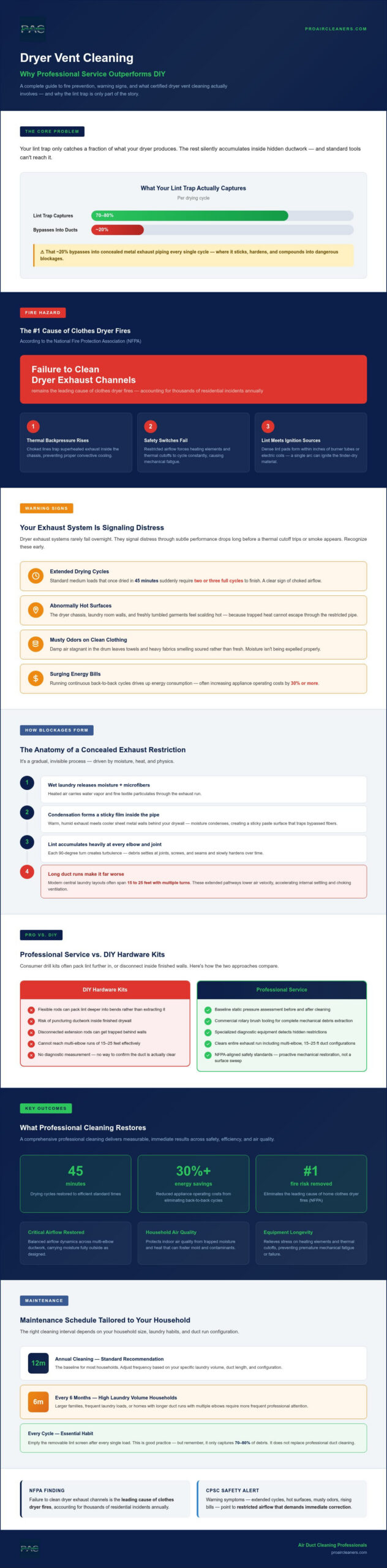
Emptying the removable mesh filter after every laundry load is good practice, but it only addresses a fraction of the total debris your appliance generates. Standard lint screens capture roughly 70% to 80% of loose fibers released during tumbling. The remaining microfibers slip straight past the screen perimeter, entering the concealed metal exhaust piping. True professional dryer vent cleaning is not basic surface dusting; it is complete mechanical debris extraction across the entire exhaust run, clearing out built-up matter that household tools simply cannot reach.
The Anatomy of a Concealed Exhaust Restriction
Understanding how a clothes dryer works highlights why internal obstructions develop so easily. Wet laundry releases pints of water vapor alongside fine textile particulates into heated air streams. As this warm, humid exhaust travels through cooler sheet metal runs behind your walls, moisture condenses along the pipe interior. This damp film catches bypassed fibers, creating a sticky paste that hardens over time.
Every 90-degree elbow creates turbulence, causing lint to accumulate heavily around joints, screws, and seams. In modern home layouts where laundry areas sit centrally rather than against an exterior wall, exhaust runs often span 15 to 25 feet with multiple turns. These extended pathways lower air velocity, accelerating internal settling and choking your ventilation system.
Fire Prevention and NFPA Safety Standards
Concealed lint accumulation is a significant fire hazard. According to the National Fire Protection Association (NFPA), failure to clean dryer exhaust channels remains the leading cause of clothes dryer fires, which account for thousands of residential incidents annually. When exhaust corridors become restricted, critical operating dynamics shift:
- Thermal backpressure rises: Choked lines trap superheated exhaust air inside the chassis, preventing proper convective cooling.
- Safety switches face extreme stress: Restricted airflow forces heating elements and thermal cutoffs to cycle constantly, eventually causing mechanical fatigue or switch failure.
- Combustible fuel collects at ignition sources: Dense lint pads form within inches of burner tubes or electric resistance coils, where a single electrical arc can ignite the tinder-dry material.
Investing in certified mechanical evacuation is a proactive measure for home health and safety. Thorough exhaust clearing restores balanced airflow dynamics, keeping your household safe and ensuring your equipment operates at peak efficiency. Understanding the full scope of dryer vent fire hazard prevention helps homeowners recognize that lint buildup deeper in the exhaust path poses risks that go well beyond what a clean lint screen can address.
Key Warning Signs Your Exhaust System Requires Professional Attention
Dryer exhaust systems rarely fail overnight. Instead, they signal distress through subtle drops in mechanical performance long before a thermal cutoff switch trips or smoke appears. Recognizing these operational shifts early protects your equipment from premature burnouts and keeps your household utility budget intact.
Operational Inefficiencies and Extended Run Times
When an internal exhaust line becomes choked with compacted lint, air velocity plunges below the minimum threshold required to carry moisture outside. Rather than discharging into the outdoors, heavy water vapor stalls inside the drum. This creates several unmistakable warning signs:
- Extended run cycles: Standard medium loads that once dried in 45 minutes suddenly require two or three full cycles to finish.
- Abnormal surface temperatures: The dryer chassis, laundry room walls, and freshly tumbled garments feel scalding hot to the touch because trapped heat cannot escape through the restricted pipe.
- Musty odors on clean clothing: Damp air stagnant in the drum leaves towels and heavy fabrics smelling soured rather than fresh.
- Surging electric or gas bills: Running continuous back-to-back cycles drives up energy consumption, often increasing appliance operating costs by 30% or more.
According to a published CPSC safety alert, these warning symptoms point to restricted airflow that demands immediate correction. If you’re unsure whether your appliance is failing or your exhaust line is blocked, reviewing common clogged dryer vent symptoms can help you identify the true source of the problem before it escalates. Arranging professional dryer vent cleaning eliminates the hidden clogs causing these efficiency losses before safety mechanisms give out entirely.
Exterior Hood and Flapper Behavioral Checks
A quick exterior inspection provides clear proof of how freely your system breathes. While the dryer runs on a normal heat setting, walk outside and observe the exhaust vent hood mounted on your siding or roofline. The damper flap should push open firmly, releasing a steady, warm current of air carrying a faint laundry scent.
If the louver barely twitches or remains fully closed, internal friction is choking the exhaust stream. Lint accumulation around the louvers or bird nesting inside the terminal hood also signals an urgent need for service. In colder regions like New England, sub-zero winter temperatures can freeze damp lint paste along the hood rim, sealing the flap completely shut and trapping carbon monoxide and moisture indoors. Professional technicians measure this performance loss using digital vane anemometers, reading exact exhaust velocity at the hood to confirm whether your ductwork operates within safe manufacturer specifications.
Comparing Professional Diagnostic Cleaning to DIY Hardware Kits
Hardware store aisles offer inexpensive dryer cleaning attachments featuring plastic bristle heads and screw-together nylon rods designed for standard cordless drills. While these kits appear convenient, understanding the mechanical difference between consumer tools and professional dryer vent cleaning explains why DIY attempts frequently fall short. Without dedicated vacuum suction and commercial gear, consumer kits often create worse obstructions than the lint buildup they were meant to resolve.
The Pitfalls of Consumer Drill-Powered Snakes
Connecting flexible nylon rods and spinning them through concealed sheet metal introduces severe mechanical risks. If a homeowner reverses the drill rotation or hits friction at a 90-degree bend, threaded rod joints easily unscrew or snap. This leaves detached brush heads trapped deep inside wall cavities, requiring invasive drywall cuts to retrieve them.
Pushing a dry brush forward without continuous suction also creates an unintended piston effect. Instead of pulling debris out, the bristles pack loose lint into dense, impenetrable dams at downstream elbows. Furthermore, stiff rods and aggressive DIY maneuvering frequently puncture flexible transition foil behind appliances, venting humid exhaust and combustible fibers straight into internal wall framing. Homeowners who notice a burning smell or unusually hot surfaces after a DIY attempt should review essential dryer vent fire hazard prevention tips to understand the hidden risks that remain even after a partial cleaning.
Commercial Tooling and Diagnostic Verification
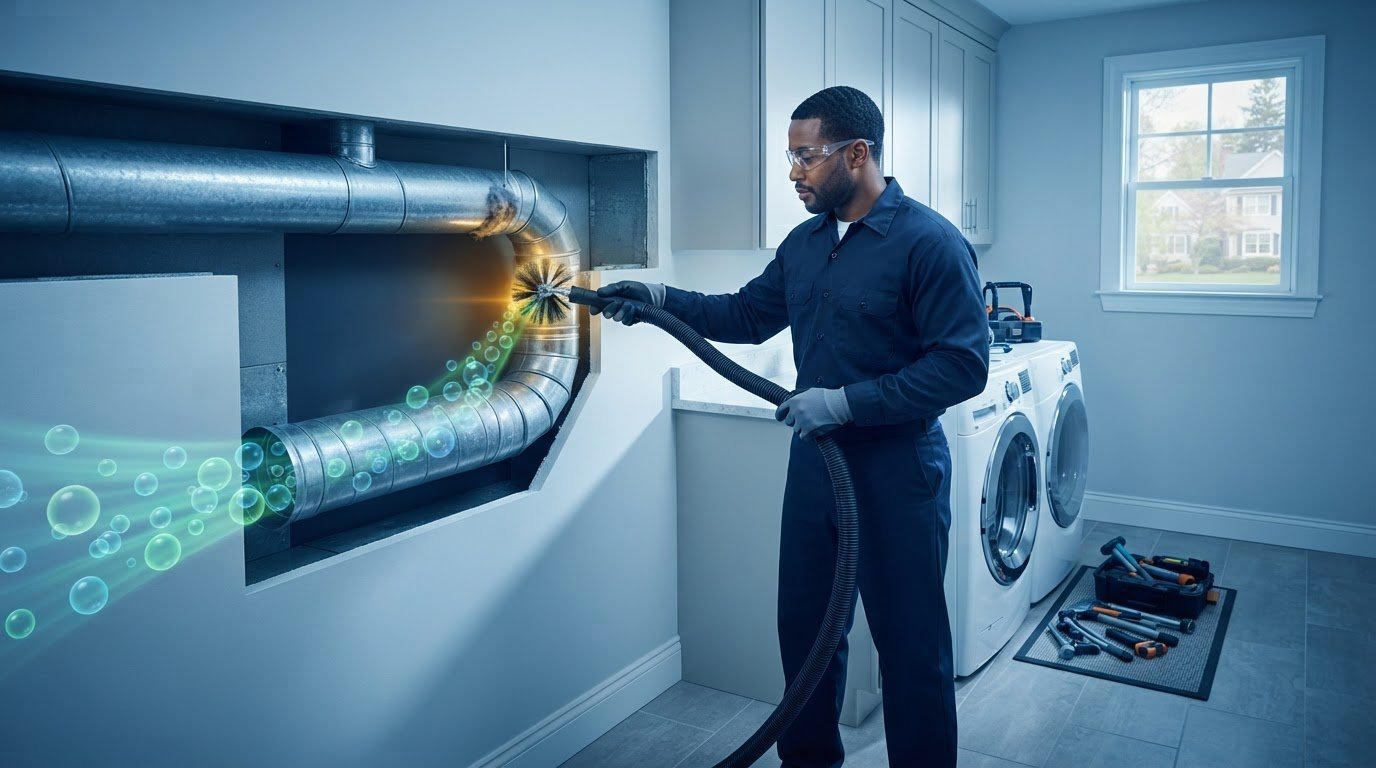
Certified specialists approach duct restoration with specialized mechanical equipment. Rather than relying on fragile snap-together rods, seasoned technicians deploy commercial-grade rotary mechanical brushes and high-torque reverse whip lines. These flexible systems navigate multi-elbow runs smoothly, dislodging clinging particulate without scoring the duct walls or risking structural disconnects.
Professional services also pair mechanical agitation with powerful negative air extraction vacuums. High-efficiency containment units capture dislodged debris under continuous suction, preventing fine fibers from settling back into the duct or escaping into your living space. To certify restored performance, technicians perform objective diagnostic testing:
- Static backpressure testing: Manometers measure internal resistance to confirm airflow meets exact manufacturer limits.
- Digital anemometer readings: Technicians capture terminal air velocity at the exterior vent cap to document complete airway restoration.
- Physical pathway inspection: Specialists verify structural seam integrity from the appliance collar to the exterior louver.
This systematic methodology ensures complete particulate extraction and mechanical safety that consumer hardware simply cannot duplicate.
What to Expect During a Professional Cleaning Service
A true service appointment follows an orderly, technical protocol designed to restore mechanical function rather than offer a cosmetic brush-through. When you schedule professional dryer vent cleaning with an experienced team, every phase of the process focuses on precision, home protection, and measurable airflow recovery.
Comprehensive Baseline Testing and Visual Inspection
The appointment begins with objective diagnostics before any equipment enters your ductwork. Technicians assess system performance and check physical layout conditions through several vital steps:
- Baseline velocity measurement: A specialist records the initial exhaust speed in cubic feet per minute at the exterior hood to establish a comparative baseline.
- Transition material evaluation: The team inspects the collar connection behind the dryer, verifying you have rigid or semi-rigid metal tubing rather than combustible plastic or thin foil.
- Pathway safety screening: Technicians inspect accessible ducting for crushed sections, disconnected elbows, or sheet metal screws penetrating the interior wall where lint snags easily.
In colder regions across Connecticut, Massachusetts, and New York, inspectors also check exterior wall caps for frost damage or moisture freezing that can cement damper flaps shut during harsh winter stretches.
Full-Length Scour, Debris Evacuation, and System Reassembly
After moving the appliance carefully and establishing floor containment, technicians attach high-efficiency particulate extraction equipment. This continuous negative air suction seals the duct, ensuring zero loosened debris escapes into your utility room or finished living areas.
Specialists then guide high-torque rotary brushes and directional air whipping lines through the entire exhaust line, starting from the outdoor termination point back toward the appliance collar. This reverse agitation breaks free baked-on lint blankets, heavy bird nests, and damp clogs around 90-degree bends without scraping thin metal walls. Once the run is cleared down to bare sheet metal, the technician reconnects the appliance transition line, seals all accessible joints with heat-rated aluminum foil tape, and runs a secondary diagnostic sweep to confirm airflow is fully restored.
Protect your household safety and lower monthly utility demands by contacting Pro Air Cleaners to schedule your comprehensive dryer vent cleaning with seasoned regional specialists.
Long-Term System Maintenance and Selecting the Right Specialist
A clean exhaust line requires a dependable maintenance schedule to remain safe, efficient, and code-compliant. Rather than treating ventilation care as an unexpected reaction to appliance failure, adopting an organized service cadence preserves equipment longevity and ensures your household stays protected from avoidable hazards.
Establishing an Optimal Maintenance Schedule
For standard single-family households running three to five laundry loads weekly, scheduling professional dryer vent cleaning once every twelve months maintains optimal airflow velocity. However, specific household factors accelerate lint accumulation and require more frequent evaluations:
- High laundry volume: Large families running daily cycles produce substantially more textile debris, quickly outpacing the collection capacity of standard lines.
- Pet ownership: Pet hair bypasses drum screens readily, combining with damp fibers to build thick, carpet-like mats inside duct elbows.
- Complex or vertical duct layouts: Second-floor laundry setups and roof-vent terminations force appliances to exhaust against gravity, leading to rapid settling along extended pipe lengths.
Homes facing these conditions benefit from inspections every six to nine months. To ensure balanced indoor air quality throughout your living spaces, pairing exhaust care with professional air duct cleaning services prevents bypassed airborne dust and allergens from circulating through your home. Bathroom exhaust fans collect dust and moisture-laden buildup as well, so bathroom vent cleaning services can round out ventilation care across the rest of your home.
Partnering with Local Dedicated Specialists
Selecting the right service provider requires looking beyond low-cost flyers or generic marketing promises. Proper ventilation care demands technicians who understand regional building designs, airflow thermodynamics, and current safety standards like NFPA 211. When vetting contractors, prioritize proven diagnostic capabilities and hands-on restoration experience over surface-level sweeping.
A qualified specialist does more than clean. They assess transition materials, repair deteriorated joints, replace unsafe flexible foil runs with rigid metal ducts, and verify that exterior termination hoods open freely. Connecticut homeowners weighing whether damaged sections need patching or full replacement can benefit from understanding air duct repair and replacement options before agreeing to any scope of work. Based in New Britain, CT, Pro Air Cleaners brings over 30 years of specialized trade experience to homeowners throughout Connecticut, Massachusetts, and New York. As seasoned local stewards of home wellness and fire prevention, their certified specialists deliver comprehensive professional dryer vent cleaning, detailed airflow diagnostics, and full duct repairs to keep your home safe and running at peak performance.
Restore Safety and Peak Performance in Your Laundry Room
Concealed lint buildup is far more than an appliance inconvenience; it is an active hazard that quietly drives up energy consumption and strains internal heating elements. Routine lint trap clearing cannot reach the dense debris collecting deep within multi-turn ductwork, nor can consumer drill snakes match the thoroughness of commercial negative air containment. Comprehensive mechanical service restores sluggish laundry cycles back to an effortless 45 minutes while protecting your property from avoidable fire risks.
With over 30 years of hands-on field experience serving homeowners throughout Connecticut, Massachusetts, and New York, Pro Air Cleaners delivers complete ventilation care, from rotary mechanical extraction to precision duct repairs and replacements. Restoring your home’s exhaust pathway provides immediate utility savings and lasting peace of mind. Schedule your professional dryer vent cleaning inspection with Pro Air Cleaners today to keep your home safe, efficient, and running at peak performance.
Frequently Asked Questions
How often should professional dryer vent cleaning be scheduled?
Most single-family homes require professional dryer vent cleaning once every twelve months to maintain safe airflow velocity. Households with large families running daily cycles, pet owners dealing with excessive shedding, or properties with second-floor laundry rooms often require evaluations every six months. For Connecticut homeowners, scheduling routine annual maintenance before winter ensures exterior exhaust dampers won’t freeze shut during freezing temperatures.
Can a clogged dryer vent really cause a catastrophic house fire?
Yes, restricted exhaust channels are a leading cause of residential appliance fires across the country. As bypassed lint accumulates along interior sheet metal elbows, backpressure traps superheated exhaust inside the appliance chassis. Highly combustible textile fibers ignite quickly when forced into contact with glowing electrical heating coils or gas burner assemblies, allowing flames to spread rapidly into concealed wall framing.
What is the difference between a DIY cleaning kit and professional service?
Hardware store kits rely on thin nylon rods that lack vacuum extraction and easily twist apart inside concealed walls. Pushing a consumer brush forward often packs loose lint into impenetrable clogs at the nearest bend. Certified technicians use commercial rotary mechanical sweeps paired with high-volume negative air pressure, capturing dislodged debris completely while protecting thin transition lines from punctures or joint separations.
How long does a professional dryer vent cleaning appointment take?
A typical residential appointment takes between 45 and 90 minutes to complete from start to finish. The exact duration depends on total duct length, the number of 90-degree turns behind your drywall, and whether the line terminates along an exterior siding wall or through a second-story roofline. Technicians dedicate this time to baseline testing, thorough mechanical agitation, joint sealing, and post-service diagnostic verification.
Will professional vent cleaning reduce my monthly utility bills?
Yes, clearing airway restrictions directly cuts excessive power and fuel consumption. When exhaust lines choke on packed lint, heavy moisture stalls inside the drum, forcing you to run redundant 60-minute drying cycles for single loads. Restoring proper cubic feet per minute velocity brings run times back to an efficient 45 minutes, saving wear on your appliance and lowering monthly utility statements.
What happens if my dryer exhaust duct is damaged or disconnected inside the wall?
A hidden duct breach expels gallons of moisture and combustible lint directly into your wall cavities, ceiling spaces, or crawlspace. This dynamic accelerates hidden structural framing rot and introduces serious fire hazards. Experienced ventilation specialists identify concealed pressure drops during initial testing and carry the necessary equipment to perform lasting sheet metal duct repairs or complete code-compliant rigid pipe replacements. Connecticut homeowners dealing with suspected duct damage can review their options for air duct repair and replacement to understand when targeted patching is sufficient and when a full section replacement is the safer long-term solution.
Can professional technicians clean dryer vents that exit through the roof?
Yes, seasoned technicians possess the specific safety ladders, fall-protection gear, and commercial snake lines required to service roofline terminations. Vertical runs represent a heightened safety risk because lint naturally falls back down toward the dryer under gravity. Professional crews clear the hood assembly, free stuck damper louvers, and extract heavy blockages all the way down to the laundry collar.